Reality of Budget 2026
UNION BUDGET 2026
2/4/202612 min read
Hello, friends!
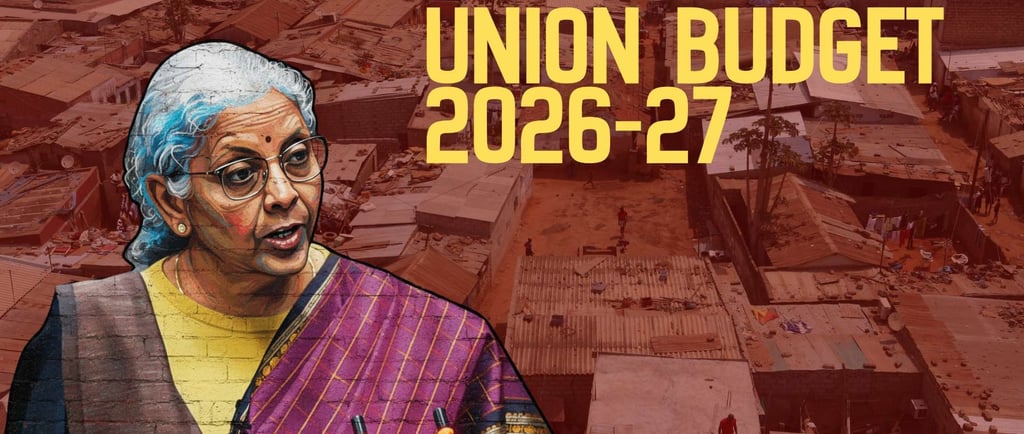
Like every year, this year too, on 1st February, India's Finance Minister Nirmala Sitharaman announced the upcoming budget for the nation. Every citizen, every taxpayer should be aware of this. Because this is when you get to know where and how the government intends to use your tax money. This year's budget was hyped to be very important. Because it came at a time when Trump poses a threat to global trade. Supply chains are being disrupted. And technologies like AI are transforming all systems.
If you listen to Nirmala Sitharaman's speech, you'll feel that India is on the verge of a major transformation. Semiconductor Mission 2.0, seven high-speed rail corridors, content creator labs, five university townships, AI tools, medical tourism hubs, mega-textile parks. The list of announcements was so long that it felt like India will emerge as a developed nation in a couple of days. But budgets aren't only about announcements. It presents actual numbers. When you look at the actual number,
the actual allocation for each of these announcements, and compare it with GDP, or the last year's figures, you will notice a pattern. A pattern that's not talked about in the Budget Speech. Leaving most people unaware. Come, let's understand the data behind this budget. First of all, let's talk about the question that matters the most to the middle class taxpayer in every budget. Will there be any relief in the income tax or not? This time, people had a lot of expectations from the government
because consumption is declining and there's a need to boost the economy. So the question is, what did they get? The straightforward answer is, nothing. Neither were the Income Tax slabs changed nor the rates. But they have provided some ease of compliance measures to make the process a bit easier for the taxpayers. For example, the deadline to file revised returns with a nominal fee has been extended from 31st December to 31st March. Apart from this, some minor offences have been decriminalised.
Like these. Also, the new Income Tax Act 2025 will come into force on 1st April 2026. Now, it's one thing not getting any relief. But on the other hand, there's an increase in the tax burden. Security Transaction Tax, known as STT in short, was raised. At present, there's a 0.02% tax on Futures trading, this budget increases it to 0.05%. The 0.1% tax on Options trading, has been increased to 0.15%. The stock market investors who trade in Futures and Options, will need to pay higher taxes.
"So today, the Government of India is earning more than the broker." This caused a stock market crash in India after the budget was presented. By the time the budget speech ended, Sensex had fallen by 2,800 points. Nifty showed heavy losses too. Now, let's take a cursory glance of the budget. How much can the government spend freely? And where is this money coming from? Because, unless you understand this, the other numbers would be meaningless to you. The total budget size for 2026-27 is
₹53.47 lakh crore. [₹53.47 Trillion] Last year's budget estimate was ₹50.65 lakh crore or ₹50.65 trillion. Compared to last year, the total expenditure of the government has increased by 5.57%. Where does this money come from? The biggest source is borrowing, making up 24%. This means that a quarter of the money spent by the government was taken on loan. This is not an unusual number because it was 24% last year too This hasn't changed much. The second biggest source is income tax, which accounts for 21%.
The third number is corporate tax, which accounts for 18%. GST and other taxes add up to 15% of the funds. This shows that the biggest contribution to the government's revenue, comes from the common people. Income tax and GST add up to 36%. While corporate tax is only at 18%. This means that individual taxpayers are paying more in taxes than companies. One thing to note here is that this wasn't the case always. During previous governments, the contribution of corporate tax was much higher.
Companies paid as much in taxes as individuals. You can see the historical record in this graph. It was only after the BJP government came into power that, companies have been getting higher relief and the pressure on individuals has been increasing. Now let's see how this money is utilised. The largest expense is paying the states their share of the taxes. A large part of the tax collected goes to the states. This is normal. But you might be surprised to know about the second largest expense.
Interest payments, amounting to about 20% the total expenditure in the budget. That is, of all the revenue earned by the government, one-fifth of it is spent on paying off the interest on loans. If we set aside the interest payments and the shares of states, the remaining amount, is then spent on other areas like, education, health, infrastructure, employment, defence, etc. These are the most important expenses that impact the development of a country. But before we get to those, I'd like to tell you something interesting about this year's budget,
this budget was presented on a Sunday. Before 1999, the Indian budgets were presented at 5 in the evening. This was the tradition since the British colonial times, because it was closer to London's time. But the Atal Vihari Bajpayee government changed this in 1999, and budgets have been presented at 11 AM IST since then. Interestingly, when the budget was supposed to be presented that year, it was a Sunday. So the government pre-poned it and announced it a day earlier on Saturday. But this year, 1st February was again on a Sunday,
but the government didn't change the date, and presented the budget on Sunday. And thus, it became the first Indian Budget, to be presented on a Sunday, a holiday. So, it's speculated that a large number of people would have watched it live.
Education. It might sound like the budget talks about education a lot. They're working on setting up 5 university townships near major industrial corridors.
This is a great idea because it will create an education-industry linkage. Apart from this, they've planned to set up girls' hostels in every district for STEM institutions. Four telescope facilities will be upgraded for astrophysics. And a National Institute of Design will be built in Eastern India. Additionally, to promote the animation, visual effects, gaming, and comics sector, they've mentioned setting up content creator labs in 15,000 schools and 500 colleges. These sound so good.
It'd be great if they actually make these happen. But the problem arises when you look at the actual numbers. The budget for education is ₹1.39 trillion which is 8.3% more than the ₹1.29 trillion last year. This seems like a good increase. But in terms of a percentage of the GDP, then education spending is still extremely low. In 1964, the Kothari Commission stated that India needs to spend 6% of its GDP on education. Then, in 2020, the incumbent government brought in the New Education Policy,
which reiterated this. 60 years have passed since 1964. It has been 6 years since the New Education Policy was announced. But still, not even 3% of the total budget is being spent on education. People might miss the importance of this. My previous video was about overpopulation. Many people commented on that video that overpopulation is a curse for unemployment. Because of overpopulation, there are so few seats in Indian colleges. Competitive exams are so tough. But do you know what, friends? The reason behind this is not overpopulation.
It is the budget for education. In previous videos, I had mentioned how countries like the Netherlands are more densely populated than India. But there, students don't face problems securing admission in colleges. It is only because, based on their population, their governments have spent on education and have built a sufficient number of colleges, universities, and schools. In India, competitive exams are not tough because of overpopulation, but because there aren't enough good colleges and universities.
Over the last 10 years, about 90,000 government schools have been shut down in India. There is a severe shortage of teachers, the infrastructure is falling apart, and the quality of teaching in the existing government schools is terrible. This budget makes no transformative announcements for school-level education reforms, teacher training or curriculum modernisation. It's great that they've announced five university townships, and the government needs to take many more such steps. Now let's talk about the health sector.
There was no shortage of announcements here either. This budget talks about upgrading existing institutions and setting up new ones for allied health professionals like physiotherapists and dietitians. It also talks about training 150,000 caregivers. "Existing institutions for Allied Health Professionals will be upgraded" The budget talks of mental health too. Apart from this, 17 cancer treatment drugs were given customs duty exemptions. It talked about setting up five regional medical hubs in
partnership with the private sector for medical tourism. But now let's look at the actual numbers. This budget provides ₹1.05 trillion on health. Whereas last year, this figure was at ₹983 billion. So an increase of about 6.4% compared to last year. Let me reiterate, these announcements sound good, but the healthcare that an ordinary Indian citizen needs, affordable, accessible, and quality primary healthcare, this budget doesn't seem to mention that. The World Health Organisation recommends
spending 5% of the nation's GDP on health. But India's health spending is still around 2% of its GDP. Think about it, friends. Education needs 6% but it's not even at 3%. Health needs 5%, but it's stuck at 2%. Same pattern. But the next section is even more shocking. Because the numbers have not increased there. In fact, they have been reduced. I'm talking about civic infrastructure. Here, the phrase Capital Expenditure is used. In short, CapEx. It is the part of government expenditure used for creating long-term assets.
Roads, railways, ports, bridges, mega buildings... This year, the government plans a capital expenditure of ₹12.22 trillion. And last year, this capital expenditure was planned at ₹11.21 trillion. It shows an increase. The budget speech talked about the concept of city economic regions too. That is, every city economic region will get ₹50 billion over 5 years. Apart from this, they've talked about developing seven high-speed rail corridors, between Mumbai-Pune, Pune-Hyderabad, Hyderabad-Bengaluru,
Hyderabad-Chennai, Chennai-Bengaluru, Delhi-Varanasi and Varanasi-Siliguri. Once again, it sounds like India is economically empowering cities. But look at these numbers. For urban development, in this budget, the government has allocated ₹855.22 billion. Last year, this was ₹967.77 billion. A marked 11.6% decrease compared to last year. On the one hand, they're talking about empowering cities economically, on the other hand, there's an decrease in government spending. Friends, this is the money used to solve ground level civic problems.
Water, sewage, waste management, public transport... Why weren't specific plans announced for these? They talk of connecting cities using high-speed rails, but the intra-city public transport, the cities that are regularly flooded when it rains, the roads that turn into drains, this budget doesn't provide for a comprehensive urban renewal program. Apart from this, to deal with pollution in cities, especially Delhi, this budget allocates only ₹10.91 billion. A lot lower than the revised estimate from last year, ₹13 billion.
In 2025-26, ₹8.54 billions were allocated. It was later increased to ₹13 billion. And this year, it has been decreased. Apart from this, this Budget also shows us, how much did the government actually spend to tackle pollution. This number will actually shock you. In 2024-25, the government allocated ₹8.58 billion to control pollution, but of this ₹8.58 billion, the government spent only ₹160 million. Less than 2%, only ₹160 million. Even though the government has the means, it isn't using it to deal with pollution.
There's a lack of intention. And now, I'm going to talk about something even more concerning. The crisis that is directly affecting the lives of millions of young people. Unemployment crisis. Today, unemployment is one of the biggest problems in India. Millions of young people enter the job market every year. And let alone quality jobs, often, they find no jobs at all. So how is this budget going to counter unemployment? We've been given a long list of schemes. In the manufacturing sector,
they've focused on seven strategic sectors. Biopharma, Semiconductors, Electronics, Rare Earths, Chemicals, Capital Goods, and Textiles. Integrated programs have been introduced for textiles. Mega textile parks have been announced. There's also a Samarth 2.0 skilling program. A scheme to revive 200 legacy industrial clusters. A ₹100 billion SME growth fund for MSMEs. They've talked of upskilling 10,000 guides for the tourism sector. They've talked of using Khelo India Mission to provide jobs for sportspersons.
"I also propose a pilot scheme for upskilling 10,000 guides in 20 iconic tourist sites." There is no end of schemes. But there's one big problem. These measures are indirect. They have not set any concrete targets for the number of jobs these will create, the job quality or by when it'll happen. Every year, 10-12 million young people enter the Indian job market. And to provide employment at this scale, this budget doesn't provide any direct large-scale employment programme.
The textiles and MSMEs that have been announced are great. I support those. But it will take years for them to have an impact. Whereas, we are going through the crisis now. Another great thing was the Education to Employment Standing Committee. But the problem remains, this doesn't provide for any concrete action. When will this committee give its recommendations? When and how will they be implemented? It can take years for the results. And no one can predict those future results. Coming to the defence sector,
the defence budget has been increased to ₹5.95 trillion. This is 11% of the total budget. Last year, the defence budget was at ₹4.92 trillion. However, no specific policy announcements were made in this sector, contrary to the hopes of the defence manufacturers. This is why, even after the increase in the budget, the share prices of several defence manufacturers crashed. "We'll take a question related to defence, government has increased the allocation, but the market didn't react positively."
Now, let's talk about the sector on which, more than half of India's population depends. Agriculture. This pattern is most clearly visible here. In this budget, the allocation for agriculture is around ₹1.63 trillion, a small increase from last year's ₹1.59 trillion. Some new schemes have also been announced such as an integrated development of 500 reservoirs for fisheries, credit-linked subsidy programme for animal husbandry, coconut promotion scheme, and focus on high-value crops such as sandalwood, cocoa. and cashew.
The question remains, how many farmers will benefit from these schemes? This budget offers next to nothing for most farmers. Issues like farm workers, fertilisers, MSP reforms, etc. weren't discussed. "For the first time in Indian history, this budget doesn't mention farmers. There are no schemes for the farmers. There are schemes for turtles, lions, but not for farmers." Finally, we come to the big question that's causing uncertainties in the world, related to trade wars and AI revolutions.
Can this budget tackle that? The Trump government has imposed high tariffs. Supply chains are being disrupted. And the future of global trade is uncertain. The budget speech mentions that, India is functioning in such an external environment where trade and multilateralism are in danger. "we face an external environment in which trade and multilateralism are imperilled and access to resources and supply chains are disrupted." This budget plans to take some serious steps in this regard.
To promote self-reliance in the manufacturing sector, Semiconductor Mission 2.0 was launched, the outlay of the Electronics Components Manufacturing Scheme was increased to ₹400 billion, and schemes were promoted for rare earth corridors and chemical parks. ₹100 billion have been allocated for container manufacturing. SEZ units have been given a one-time facility to sell their products at concessional rates in the domestic market. This is directly in response to global trade disruptions. Duty concessions were announced on seafood, leather, textiles, etc. to boost exports.
The ₹1 million consignment cap on courier exports has been withdrawn. But one thing that can be spell uncertainty is that foreign companies have been given a 20-year tax holiday to set up data centres in India. Friends, you might not know that large scale data centres are needed to power AI apps. And these data centres consume a lot of energy and water. In countries like America, people are already voicing their concerns about data centres. Because in many places, these data centres have polluted the water bodies.
Like this case. "Look at the water pressure in the kitchen. This is where I fill up water for storage. Those are the things we have to fill up to flush the toilets." "So, you can see the sediments from the data centre." "Wow, and that's just from the water coming out of your faucet?" "Yeah, and this is what's in all the pipes." Now, setting up such data centres in areas with sparse population, and an abundance of renewable energy, makes sense. But for a country like India, if the government invites foreign companies
to set up data centres in India and gives them tax breaks for 20 years, think about how it will impact Indian resources. "I propose to provide tax holiday till 2047 to any foreign company that provides cloud services" In India, soil and water pollution are already major concerns. And energy isn't so abundant that we can be wasteful about it. It's clear that these companies will benefit a lot. But what will be the consequences suffered by the common masses? This budget mentions AI in several other places too.
AI applications were said to be useful for better governance. They've talked about a multi-lingual AI tool called Bharat VISTAAR. The Education to Employment Standing Committee has been tasked with the responsibility to assess the impact of AI. "The Government has taken several steps to support new technologies through AI Mission..." But there were no dedicated, major allocations for AI. Apart from this, globally, millions of jobs are in danger because of AI. Firms like McKinsey and Goldman Sachs state that
globally more than 300 million jobs can be disrupted by AI. But there doesn't seem to be a clear plan to address this. Friends, there you have the complete picture of Budget 2026. As I mentioned in the beginning, there's a clear pattern to it. Education, healthcare, civic infrastructure or agriculture. We've heard pleasant speeches, several schemes were announced, But the numbers show that it won't have a significant impact. The performance of previous budgets gives you an apt idea.
10 years ago, those budgets promised a lot too. 100 smart cities were going to be built. And numerous such headline grabbers. But you can see for yourself how they've performed.