Reality of Civic Sense in India
The Problem is NOT What You Think
2/15/202615 min read
in Copenhagen, Denmark, you can find a clean public toilet every five minutes on foot. The streets there don’t have any potholes. Everyone drives within their lanes, and there’s no honking noise. If you’re walking on the road, there are sidewalks everywhere, and cars stop at zebra crossings to let you cross. People’s civic sense is so good that even when standing on escalators, they stand on one side so others in a hurry can walk up the steps quickly.
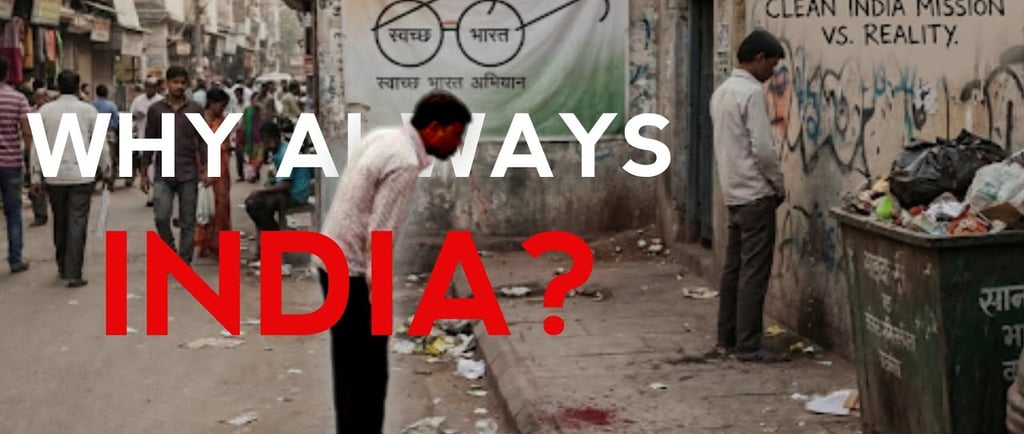
The whole city’s public parks are so clean that you won’t find a single piece of trash anywhere, and you even get paid for returning plastic bottles. Now, compare this scene to India. In most cities across the country, there are piles of garbage everywhere. Every street corner and intersection is littered with trash. You’ll see people cleaning out the drains by crawling inside them. Public toilets are in such bad shape that people end up peeing on the streets. The noise from car horns is so loud that most people can’t even enjoy peace in their own homes.
You can hear horns honking while just sitting around. Sidewalks and zebra crossings are barely visible in many places. On top of that, people behave like there's no line anywhere—they just cut in wherever they want. They throw trash anywhere without a second thought. That uncle is throwing all the garbage right onto the tracks. This is the state of Indian Railways. Senior staff picking up all the trash and throwing it outside. Hey uncle, that’s not a restroom, it says ‘Ministry’—peeing here is strictly prohibited. These are like two different countries, two different worlds. But the question is, are people in Denmark just born more...
Have we really become civilized? Do Indians just naturally have less civic sense? Here, take a look for yourself. The answer is obviously no. Actually, the formula that developed countries like Denmark use is really simple—once you hear it, you’ll think, “Oh, it’s just that simple.” But at the same time, the issue of civic sense is much deeper and more complex. Believe me, what I’m going to share with you in this video will completely change the way you think. The problem with civic sense, friends, is connected to three other problems that most people don’t really talk about, or rather...
People don’t want to do this. The first problem here is casteism and classism. Casteism runs deep in our country. Listen carefully. Who here is going to vote for BSP? Why are you sitting down there? Why are you sitting down there? If you sit down there, I’ll leave from here. You sit here. No, you can’t sit on the platform in front of me. Traditionally, cleaning has been the work assigned to certain castes. Gandhi said that these people are like a mother to society. Just like a mother keeps her child clean to protect them from diseases, these cleaners keep things clean and protect society from illnesses.
Now, Gandhi gave them the status of a mother, but people have looked down on them so much that their name is used like a curse word. Like, if someone steps on me, I start thinking, "Man, this is not looking good at all." Just think about it. In a country where sanitation workers are treated like this, where cleaning is seen as something shameful, how can cleanliness ever improve? Just check out this recent news from politics: in Dhanbad district of Jharkhand, a 46-year-old Dalit woman was assaulted and...
She was called caste-based slurs. You want to know why? Because this woman refused to clean for free for a shopkeeper. The truth is, friends, most of the sanitation workers in our country today are still Dalits. It's not about whether they're Dalit or from any other caste. The real problem is that they’re forced to clean inside the gutters. Many times, they die from poisonous gases. Is our country so poor that someone has to crawl into gutters to clean, and we can’t even afford machines? Absolutely not. Our country is not that...
They’re not poor, just indifferent. When a lot of Indians settle in foreign developed countries, they clean their own homes because hiring domestic help is too expensive. But in India, poverty and unemployment are so high that we can auction off labor. You can get your house cleaned for very little money. Now, I want to ask you—what about the person who comes to work in your home? Do you treat them with respect? Do you treat them respectfully? We have...
In most societies, they even have separate lifts just for them in their apartments. If they want some tea or water, separate utensils are kept for them. This wrong mindset actually starts from here. People don't consider cleaning their responsibility. In schools, homes, offices, there’s always someone else who comes to clean. The ones who come to collect our garbage—we don’t call them cleaning staff, we call them ‘the garbage guy.’ And that’s the real irony. We’re the ones who create the trash, but we label them as the trash guys. Who are these people? Where are they from?
Where do these people come from? Mentally and physically, they completely dissociate themselves from cleaning their own identity. This is a huge difference from developed countries. Whether it's Canada, Germany, Japan, or Australia, people there separate their garbage themselves. Most people clean their own homes. But in our country, does anyone stand on a mountain of trash and sort it out? And what’s our leaders’ plan for cleanliness? Now, every 15 days, our minister goes to the garbage dump and stands there telling the trash, "You’ll have to go, brother."
The other problem is with the government system here. Have you ever seen clean public toilets in your city? I’m not talking about malls, I mean actual public toilets. In more than half of them, there isn’t even running water. You have to bring water from home. Yes, you have to carry water yourself. There are even toilets where you have to bring your own water and clean up after yourself. Just think about that—what’s the point of having a toilet then? The smell is so bad that you either feel like you’ll die from the stench or from the urine.
They’re gonna get a tract infection for sure. Just look at the state of this place. Everyone’s peed here. The smell is so bad. Imagine, people only have one sense left — that they’re peeing right here. But let me tell you a sad reality. This is actually a restroom, but it’s locked. Got it? People are forced to pee here because of that. And think about the women’s restroom — it’s locked too. So where are they supposed to go? People say it’s a lack of civic sense, that folks just pee out in the open. But think about street vendors who are out all day, away from home. They’ve got nowhere else to go.
People are going to pee anyway. Either give them access to clean public toilets in malls or provide space in markets for them. Put common toilets in those markets. But that’s not happening either. Think from their perspective—when there’s no other option left, of course they’ll just pee by the roadside. Similarly, are there sidewalks everywhere? Are there zebra crossings everywhere? No, they’re not. Are lane markings and road signs properly done so people know where to turn? No, they’re not.
In our country, flyovers are built where suddenly there's a 90-degree turn. Or look at this flyover that suddenly goes from four lanes down to two. With all this kind of infrastructure, how can you expect people to stick to their lanes? The surprising thing is, everything’s upside down here. People aren’t standing up for their rights. Instead, they’re busy blaming each other. There’s zero common sense. Zero. Someone’s probably shooting a video, so they just cut in. Where’s the civic sense? Sure, some people have it, but...
(it’s not like that. . But what’s the point of just brushing everything off by saying people lack civic sense? Modi ji, Modi ji, these people are so shameless. They die on purpose. They keep dying again and again just to defame you. Modi ji, these people don’t have any civic sense. They don’t. The public isn’t fooling you. Modi ji, the fault lies with the public, right? You can just dump this public into the Indian Ocean and order a new, better public from Amazon or Flipkart. Hope you get what I’m saying now)
Of course, you can't just bring in new people from somewhere else. We have to educate the people who are already here in this country. But who will teach them? How will civic sense come? Influencers and content creators who talk about this are doing what they can from their side. But you or I can't force anyone to learn, right? We're not the police, nor are we the government who can make new laws. We can't fine anyone for doing something wrong. So, obviously, this job has to be done by the government. Whether...
There should either be a part about civic sense taught in the school curriculum, or people should be fined for littering. But you can only fine people for littering if there's already cleanliness and a system in place somewhere first. Just think about it—someone living in a smelly slum, where every corner of the street is piled with garbage, mud is everywhere, dirty water is standing around, and mosquitoes are buzzing. Their kids don’t even have clean toilets in government schools. You can imagine how bad the smell must be. If someone has never seen cleanliness until now, then what can you expect from them?
You want to teach civic sense? First, make sure the place is clean; only then can you tell someone not to make a mess. Put dustbins in place first, then you can tell people to throw garbage in the bin. Build public toilets with cleanliness, water, and soap, only then can you ask people to use the toilets. After that, people will flush. Have sidewalks along the roads, bike lanes, and beautiful flowers planted everywhere. Only then can you tell people not to pluck the flowers. But if a person from this dirty slum goes to a clean, fancy society where...
They’ll see flowers. So obviously, it’ll want to pick those flowers because this is its first time seeing something beautiful. I’m not saying it’s okay to pick flowers, I’m just saying try to see it from its perspective. Someone who’s never seen clean, beautiful things in their life—how do you think they’d behave? The thing is, folks, people here have this herd mentality. A sheep-like attitude. When there’s trash everywhere and everyone’s spreading more trash, they don’t even hesitate to roll down their car window and throw wrappers on the street.
It doesn’t happen. But in places that are clean, where people feel like if they litter, everyone will notice them, those same people hesitate to throw a chip wrapper. You can see this example in Indian cities too. Take the Delhi Metro, airports, or malls for instance. Except for a few stubborn ones, most people actually don’t litter in these places. They’re worried about what others will think of them. They don’t want to be noticed. And that’s mainly because these places are already kept clean.
The system is set up that way. So until the government takes the first step here, achieving anything is really, really tough. And unfortunately, guys, the situation is so bad that not even in the government’s manifesto does it say they’ll clean your area. Even the poor folks who deliver Zomato Blinkit orders for ₹10 are forced to rely on free grain. They don’t even dream of having clean streets, trees planted, flowers blooming, or dustbins around. So it’s pretty clear that if the system is right and the tools are in place, results will come automatically—even if people’s civic sense isn’t great.
Now, let’s talk about the third problem behind civic sense here, which is apathy. Rich people, they might talk about cleanliness on the surface, but when it comes to reducing waste, having good waste disposal systems, making compost pits, or better urban planning—they’re not really willing to get into those details. They’re happy living in their own bubble, buying flats worth crores, with swimming pools and tennis courts inside the apartment complex.
The gym might have everything, but the neighborhoods around it are filled with filth and heaps of garbage. In drone images of many cities, you can clearly see the gap between the rich and the poor. There's a wall that stands out clearly. The wealthy people living on this side of the wall have never dreamed of making the entire city beautiful. The feudal mindset is deeply ingrained in their brains. They don’t have any sense of community. Just think about it—billionaires like Ambani and Adani have so much money that if not the whole city, at least one part could be made beautiful.
They could totally clean up a huge part of the city, but they won’t spend any money on it. Instead, they’ll build a big, tall palace right in the middle of all that filth. Inside their palace, they’ll have all the luxury stuff, but they won’t care at all that outside their window it’s all garbage and dirt. No god or wise person is going to come and magically make people feel like a community. Here’s the message I want to give you: you’ve got to have empathy for others. You need to think about how your own mess affects everyone else.
Someone else will have to clean it up, so I won’t make a mess. And you’ll think about this only after you step outside the house. This mindset should be there inside your home too. Wherever you make a mess inside—scattered stuff, dirty dishes, calcium buildup in the bathroom—take responsibility for it and think about it. When checking out of a hotel, you should throw your empty water bottles and empty packets into the trash yourself. After eating at a restaurant, gather all your dishes in one corner of the table with your own hands so it’s easier for the waiter to collect them.
When you’re leaving, hold the door for the person behind you. The day these little changes become part of your behavior, your empathy will truly awaken. You’ll start feeling concern for others, and that’s what we call civic sense. it’s the government’s job to fix this. They need to include lessons on civic sense in school curriculums and teach in class that casteism is a mental illness.
Cleaning is nothing to be ashamed of; it’s something to be proud of. People should be taught to respect sanitation workers and how to separate their trash properly. If you’re watching videos in public, use earphones so you don’t disturb others. All of this needs to be taught in schools. Also, there needs to be a proper system in place, and clear rules to maintain that system. There are always careless people everywhere, even in developed countries. But the difference is, their systems are built so that those people get punished, and the rest aren’t bothered.
No, there’s no need to give super harsh punishments here. Instead, the focus should be on making the chances of getting caught and punished really high. Even if it’s just a ₹500 fine or a one-day jail term, people need to know they won’t get away with littering. You’ll have to pay the fine or spend that day in jail. Doing this will naturally build a sense of civic responsibility. Gradually, people will start caring about others and develop a sense of community. That’s what you see with people in Denmark—they have a strong community feeling.
They say "SAMF" means social mindedness—putting the interests of society above your own. This vibe was really clear in Denmark, even during the COVID times. In India, some people think civic sense can only be enforced by strict punishments, fines, or even jail. But honestly, empathy makes a way bigger impact than all that. It’s about making people genuinely care for one another. In Denmark, people actually care about each other. They follow rules in shared spaces and keep public places clean. They treat others with respect.
They do this because they’re socially aware. And that’s enough to develop civic sense. Actually, there’s another reason too — there’s no casteism there. Whether someone is poor, a sanitation worker, or housekeeping staff at a hotel, they’re seen as human beings. Cleaning work is respected there. In India, people are still confused about sorting waste into dry and wet categories. But in Denmark, waste is sorted into 10 different categories — glass goes in one bin, metal in another, plastic separately, paper separately, food waste in another, and so on.
Drink cartons separate, cardboard separate, textiles separate, food waste separate, hazardous waste separate, and residual waste separate. People don’t wait around for some garbage collector to come and sort their trash into 10 different categories. No way. People set up dustbins at home to separate their trash into those 10 different types themselves. They create 10 different compartments right at home. And it doesn’t stop there. Usually, only the most common type of waste gets picked up from your house. But what about hazardous waste, textiles, electronic waste?
You have to collect it yourself and take it to a recycling center. Usually, in a city, there are three to four recycling centers where you can drop off the waste. People have to go to these centers themselves to deposit their trash. Just think, if this happened in India, most people would probably be too lazy and end up throwing hazardous waste in with the regular garbage, which they actually do now. But in Denmark, people go through the trouble of going to the recycling center because they know what happens if hazardous waste ends up in the environment.
If it spreads in our city, it'll only hurt them. And this isn't just about Denmark. The same thing happens in most developed countries like Germany, Switzerland, and New Zealand. In Switzerland, there's a cost for trash disposal. You can only throw away your household garbage in municipal bags, and you have to buy these bags. On the other hand, recycling services are provided for free to encourage people to recycle. The biggest challenge in recycling is plastic bottles and aluminum cans. In India, plastic...
The problem is so big that whether it’s Pangong Lake in Ladakh or Sukhna Lake in Chandigarh, whether it’s Kerala or Manipur, plastic waste is everywhere. But you won’t see this problem much in most European countries because places like Denmark and Germany have a deposit system for plastic bottles. You’ve probably seen vending machines where you put in money and get bottles. Here, they have reverse vending machines where you put in empty bottles and get some money back. Actually, whenever you have a plastic bottle...
When you buy something, you always have to pay a little extra money, kind of like a deposit. Later, when you bring back the empty bottle to these reverse vending machines, you get that deposit money back. This whole system isn’t about fines; it’s about rewards. It motivates everyone not to throw plastic bottles anywhere because there’s money in them. When you return them, you get your money back. Denmark’s Bornholm Island is actually trying to become completely waste-free. That means everything on the island...
Whatever is produced will be reused or recycled. The idea is that by 2032, this place will become the world’s first waste-free community. Exactly how they’ll pull this off is a pretty interesting story. We’ll talk about that another time. But this attitude is something you see everywhere in Denmark. In Denmark’s capital, Copenhagen, cycling is super common. It’s one of the most bike-friendly cities in the world. About 64% of commuters there travel only by bike. Plus, they’ve created sustainable 5-minute neighborhoods, where you only need public transport and...
With a bike, you can get to your workplace, go to school, or even go shopping. Everything you need is within a 5-minute radius. This encourages people to get out and about more. People stay healthier, and there’s much less use of cars. In Denmark, they’re also using climate-friendly asphalt to cut down on CO2 emissions. Trees are planted along the streets to provide shade and help control the temperature. Most developed countries follow a pedestrian-first approach.
So basically, if any pedestrian steps out to cross the road, vehicles have to stop right in front of them, no matter if there’s a traffic light or not. Also, nobody will honk. Actually, the whole honking thing is pretty interesting because India is one of the only countries in the world where people honk all the time for no reason. In other countries, honking is so rare that you might hear it just once or twice a month. That keeps the roads much quieter. In India, we usually see that to so-called develop an area...
To make residential areas, they completely remove nature from the spot and then build buildings with grassy parks in between. But in Denmark, you see climate parks where nature is allowed to stay in its natural form. All of this works as a kind of holistic solution. People only start thinking about these things when they genuinely care about their community and the people around them. This also creates a positive feedback loop.
When things are clean, the environment is nice, the air is fresh, and efforts are being made to stop climate change and reduce noise pollution, people naturally feel a stronger sense of community. In Singapore, there’s the Restroom Association of Singapore that inspects public toilets and rates them three, four, or five stars. Toilets that score well get a "Happy Toilet" logo, and the association promotes them on their website. Similarly, in Japan, kids are taught civic sense in school. Children learn to...
Students clean their own classroom corridors and toilets. They get about 15 to 20 minutes for this either after lunch or at the end of the school day. This practice is called "osoji." It's inspired by the philosophies of Buddhism and Shintoism, which promote cleanliness, mutual harmony, and respect for shared spaces. Similarly, in European countries like Germany, Sweden, the Czech Republic, and the Netherlands, schools teach kids recycling and waste management practices from a young age. Just like that, lining up properly is taught in England’s...
It's in their blood. In the citizenship test, they might even ask you about standing in line properly. Canadians are known for being super neat and orderly when it comes to queuing. In countries like Russia and the UAE, you can see escalator addicts—people stand on one side and walk on the other. Systems can be designed for stuff like this too. Like, why are fast-track lanes managed by a manager? You've probably seen this at airports. So why isn’t the same done at railway stations or during community meals or temple queues?
Why doesn’t it happen? Why do we think it’s okay to let these poor people climb over each other? Why do we allow stampedes there?