Reality of India's Partition
Partition
1/30/202617 min read
Hello friends, in August 1947, a man was sitting in a closed room in Delhi and was drawing lines on a map. In front of him were some papers, some population tables and a pencil. The man who was going to draw a line with this pencil had no idea that 2 crore people would leave their homes because of him. He didn't know that lakhs of people would be killed because of him. He didn't even know where the lines he was drawing were. Until a few days ago, this man had never seen India in his entire life.
He didn't even write a word about India. He didn't even know where Punjab and Bengal were. But the British government wanted such a man. A man who could draw the border between India and Pakistan. Who was neutral, without any bias. Who was neither on the side of Congress nor the Muslim League. And he had found this man. Sir Cyril Radcliffe. He was a well -known English lawyer who was one of the most respected legal mimes in Britain at that time. The fact is that a few weeks ago, on 3rd June 1947, at 4pm,
a voice echoed on All India Radio. This was the voice of India's last Viceroy, Lord Louis Mountbatten. He had announced in clear words that the British were leaving India and freedom would be granted on 15th August 1947. But there was only one condition that this country would be divided into two parts. There can be no question of coercing any large areas in which one community has a majority to live against their will under a government in which another community has a majority. The only alternative to coercion By this time,
the British realised that they were sitting on a ship filled with explosives, which was on fire. They wanted to get out of here as soon as possible. And in this haste, they decided to make history. most dangerous decision in history. The decision to partition India. It was not just about India and Pakistan. It was also about the 565 princely states. Many of the kings were thinking of creating an independent country. And if that happens, there would be more than 500 holes in the map of India.
let's know the story behind this border in depth. How was this line drawn? Why did lakhs of people have to become refugees here? Why did we witness violence on a large scale? And how were these 565 kings convinced to come here? Before the partition, the question was what would be the names of both the countries.
Muhammad Ali Jinnah wanted Pakistan to be his country. Whereas Congress wanted India to remain India. But Jinnah had a problem with the name India. He wanted the name to be Pakistan and India. And he wanted them to be together. them India by combining them. On the other hand, the leaders of the Congress said that Pakistan is being formed by breaking away from India. Why did India change its name? Jawaharlal Nehru put this demand in front of Mountbatten. And he found this demand logical. So he agreed to it.
This upset Jinnah a lot. But the more important question was that when both the countries were divided, where would the border be? Nehru and Jinnah mistrusted each other so much that they couldn't agree on any line. For this reason, the British chose a man from London who had nothing to do with India. And this man was Sir Cyril Radcliffe. In 1947, Radcliffe arrived in India. He thought he would have a lot of time to do this division. But Mountbatten told him that he had only 15 August. India is quite simple.
All you've got to do is draw a line. One that cuts through the Punjab. And in the next few weeks, they wouldn't have time to roam around. They wouldn't be able to see the places they were distributing. Radcliffe was given four local advisors to help him. Two of them were from Congress and two from the Muslim League. But they also used to fight with each other. Although the basis of the distribution was clear. The districts where the majority of Muslims are, will go to Pakistan. And the districts where the majority of Hindus and Sikhs are,
will stay in India. But the map that Radcliffe had was not exact. And the figures of the population were also not that reliable. Two cities became the biggest problem and came in front of Radcliffe. Calcutta and Lahore. They gave Calcutta to India because the Hindu population was high there. But in Lahore, 500 ,000 Hindus, 106 ,000 Sikhs and 600 ,000 Muslims lived. So no one had a clear majority here. Lahore, gentlemen. Lahore. The city has art, culture, and goods for export. I agree that the population is more of Muslims.
But most of the industrial businesses are of Hindus and Sikhs. Radcliffe first thought of giving Lahore to India. But then he thought that if both the big cities are given to India, then Pakistan won't have any major urban centres. That's why finally, he gave Lahore to Pakistan. But friends, the distribution of the country was not only of land. Everything had to be distributed. Every file, every furniture, from every ceiling fan to every board pin. A very strange case was found. In 1946,
the Bengal government had ordered 60 ducks from England. In July 1947, when these ducks reached Calcutta, a bill of 250 pounds was also issued. But the question was, whose ducks were these? West Bengal's or East Bengal's? Or they could be divided into 30 -30 groups. The finance secretary stopped the payment. The ducks were neglected in the warehouse. And from ducks to typewriters, soap cases to library books, there was a fight on everything. Radcliffe refused to take a 2000 -pound fee to build the border.
He said that he considers it his duty for the British Empire. 2000 pounds is agreed. Your Excellency, I was raised to believe that duty is above all else. But he had no idea how many lives would be destroyed. On the morning of 13th August 1947, Mountbatten was given a report of the Boundary Commission. Mountbatten took this report and locked it in a safe. The thing was that he wanted to keep this decision a secret till 15th August. He believed that whatever decision Radcliffe would have taken, both the countries would be upset with him.
Mountbatten felt that first, he should let the people celebrate their freedom. After that, he would deal with the problem of the border later. On the morning of 15th August 1947, India and Pakistan's freedom was celebrated all over the world. But millions of people didn't know which country they were citizens of. District magistrates didn't even know where to report them. In Delhi or Karachi? Finally, in Mountbatten's sealed envelopes, Prime Minister Nehru and Prime Minister Liaquat Ali Khan were given a report on the
border. They were suggested to go to different rooms and study this report in detail. And understand the borders of India and Pakistan. For two hours, they studied it in separate rooms. And later, they met Mountbatten for a joint meeting. When they returned after two hours, they were furious. Why in God's name has it been awarded to India? Its properties, its commerce, everything is primarily owned by Hindus and Sikhs. Anger was about many things. But the biggest controversy was about a small city.
Gurdaspur. Radcliffe, following the natural boundary of the Ravi river, put this Muslim majority area in India. Because without Gurdaspur, India has no practical land access to Kashmir. And Kashmir has no choice but to go to Pakistan. Pakistan was not happy with this at all. Unintentionally, this line of Radcliffe gave India a way to claim Kashmir. What the hell is this, Your Excellency? Gurdaspur is Muslim territory. Why in God's name has it been awarded to India? On 17th August, these boundaries were publicly announced to the public.
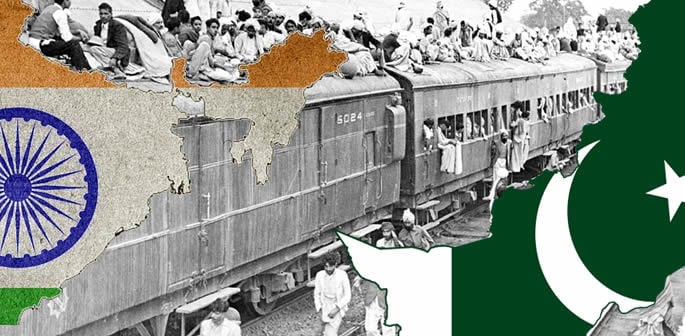
In Punjab, the biggest migration of human history is seen. This line of Radcliffe had left 50 lakh Sikhs and Hindus in Punjab, Pakistan. And more than 50 lakh Muslims in Punjab, India. Now all of them had to leave their homes and go to the country that belonged to them. A country that most of the people had never seen before. On the streets of Punjab, covered in dust, 50 -50 miles long lines of people were walking. There were old people in bullock carts, children on the shoulders of their parents,
and things on their heads that were not theirs. entire family. Here you can see a video of the actual footage taken during the migration. All these people were going towards a country that they had never seen before. So obviously, these people were very upset. To maintain peace, the government had formed the Punjab Boundary Force. An army of more than 55 ,000 soldiers, which would maintain law and order. The Governor General has proposed to form a Boundary Force. But 55 ,000 soldiers, in front of 2 crore people,
were nothing. The madness that was seen here, the scariest example of it was trains, which people called ghost trains. On the evening of 15th August, at Amritsar Railway Station, the No. 10 Down Express from Lahore was waiting. Usually, in every such train, people would knock on the doors and push each other. It was a very lively atmosphere. But when this train arrived, nothing like this happened. No one got down from this train and there was a terrible silence on the platform. When the door was opened,
it was found that this train was full of corpses. On the wall of this train, it was clearly written in big letters. This train is our independence gift to Nehru and Patel. But this was not the only such train. Such trains were coming from both sides. From Pakistan to India and from India to Pakistan. Despite such difficult circumstances, the real nightmare of the government was not Punjab, but Calcutta. We have a message from the Prime Minister. that the Hindus of Calcutta are going to avenge the Direct Action Day.
For Punjab, they had made a boundary force of 55 ,000 soldiers. But for Calcutta, they had nothing. If we assign all the units to Punjab, there will be none left to stop this bloodbath in Bengal. Mountbatten knew that once violence started in the slums and congested bazaars of Calcutta, no army would be able to control it. The streets of Calcutta are very different from the fields of Punjab. To control violence in Calcutta, they needed a miracle. A miracle. That's why at the end of July, Mountbatten went to meet Mahatma Gandhi.
Mountbatten made a very strange request. He said, maybe you can do with the power of your personality and non -violent ideals what no army can do. He said, you help us in Calcutta. You'll be my one -man boundary force. On 13th August, Gandhi reached Calcutta. To stay here, he chose Belia Ghata's Haidri House. An abandoned, dilapidated, dirty house. But the most shocking thing was that he started living here with Shahid Surawardi. The same Surawardi whom the Hindus called the Butcher of Calcutta.
In August 1946, he was the Prime Minister of Bengal. And on Direct Action Day, he was also responsible for the deaths of thousands of people. But now, Surawardi needed Gandhiji to save the lives of the Muslims of Calcutta. Gandhi put two conditions before him. First, Surawardi had to take a pledge from Noah Kali's Muslims. That he would keep the Hindus safe there. If even one Hindu was killed, Gandhi would go on a hunger strike against him. And the second condition was that Surawardi had to live with Gandhi in his house.
Without any weapons, without any security. The start of this plan was not good. Gandhi's supporters got upset with him. But because of this, a miracle happened on 15th August. No riots were witnessed. Those who became enemies of each other in the name of religion began to hug each other on the streets. There was no violence for 16 days. But slowly, the horror stories from Punjab began to spread. Calcutta. And there too, violence erupted. A little away from the Hyderi House, two hand grenades were thrown on a truck that was taking the Muslims.
Gandhi immediately reached there. On the same night, Gandhi announces that to maintain peace in Calcutta, Gandhi ji is going to perform Amarand Anshan. The Calcutta Bureau has reported that to stop the increasing violence in the city, 78 -year -old Gandhiji has announced his death anniversary. On 1st September 1947, Gandhiji started his fast in the night. And within 3 days, he becomes very weak. So weak that his voice is not coming out. News started spreading among people that Bapu is sick, his health is deteriorating.
The atmosphere in Calcutta started changing. People took pictures of Bapu and took to the streets. As the news spread that Gandhiji was very sick, Hindus and Muslims came together in support of him. Common people started appealing from home to home, please stop the violence, no more violence. And then something happened, friends, that no one had even thought of. 27 goons who had participated in the riots, come to the door of Haidri House and confess their crimes in front of Gandhiji. That same evening,
the goons who were responsible for the murders of Muslim labourers also arrived. And then they placed their knives, guns and all other weapons at Gandhi's feet. Gandhi ji said, those whom you have harassed, now protect them. Those who had picked up weapons to kill Muslims, now go out of their homes and On the evening of 4th September, after 73 hours, Gandhiji broke his fast. This is called the miracle of Calcutta. The work which couldn't be done by the police force of 55 ,000 people was done by
an old man without any weapons. This thing was so unbelievable that you won't believe it, friends, that from this point till the time Gandhiji was alive, Calcutta was under his control. saw a communal riot in Calcutta. But coming back to the partition, it wasn't just between India and Pakistan. In 1947, more than 500 princely states, i . e. Rajwade, in the geography of British India, Many decades ago, the British East India Company signed a treaty in which the company was considered a paramount power.
This means that legally, these kingdoms belonged to the Nawabs and the Maharajas, but the Britishers decided everything. Instead of making these kings the kings, they gave heavy subsidies to the Britishers. Along with political dependence, there was also economic dependence. Raw materials, industrial goods and jobs were all dependent on British India. But when the cabinet mission came in 1946, it only focused on the questions of Hindu -Muslims. Princely states were not even mentioned. On 3rd June 1947,
when the British announced that they were leaving two different countries, two dominions would be formed here. Even then, it was not clear what would happen to these princely states. Because of this ambiguity, some kings started dreaming of creating an independent country. These Rajwadis said that they had given this power to the British. And now when the British are leaving, they should return their power. In total, there were 565 princely states. Although most of them were in very small regions in India.
But giant states like Hyderabad and Kashmir were also a part of them. If giant states like Hyderabad and Kashmir became independent, they would have been larger than many European countries in size. And on top of that, if they had been freed, India's map would have looked like a Swiss cheese with more than 500 holes. Sardar Patel knew that if these 565 states became independent, India would never be able to survive. That's why he took the responsibility of uniting the states with India.
Mountbatten proposes a deal to Sardar Patel. If Congress allows these kings to keep their names, titles, palaces, privy purses and privileges, Mountbatten himself convinced the kings to join India before 15th August. These princely states gave them the analogy of apples. One apple for each princely state. Sardar Patel said that if Mountbatten gave them baskets full of apples, they would be ready to take it. Mountbatten said that he would leave six of them and bring the rest. They will offer the princes some Mountbatten.
565 minus 6. That means Mountbatten had to pluck more than 550 apples. That too, before 15th August. In the midst of all this, Jawaharlal Nehru offers Mountbatten to become the first Governor General of independent India. Think about it. The British Viceroy who has just divided the country, should be given the biggest constitutional post in India. This was not a flattery from Nehru's side. Rather, it was a well -planned strategy. A strategy. Both Nehru and Patel knew that Mountbatten had a connection with the British Crown.
and influence on the kings. The merger of the princely states, the division of assets, disputes like Kashmir, a friendly Mountbatten could be very useful in all of this. Mountbatten is the cousin of the king of Britain. We stay on the streets, he stays in the palaces. So it is more likely that the people of the palaces will understand the language of the people of the palaces soon. But Pakistan did the opposite. Jinnah made himself the Governor General. Mountbatten tried to convince him that the real power in the British constitutional
system lies with the Prime Minister. Jinnah should have been the Prime Minister instead of the Governor General. But Jinnah didn't agree. He said, So in this way, friends, Mountbatten became the Governor General of India. And one by one, he convinced the kings to join India. Apart from this, Sardar Patel gave this task to a man who was one of the most powerful Indian civil servants of British India. His name was V . P. Menon. He was also the advisor of Mountbatten, with whom he could coordinate well with Mountbatten and Patel.
Patel wanted a man who could talk to the kings, explain to them and scare them when needed. Mountbatten and V . P. Menon meet the kings one by one. Some are explained, some are scared and some are given deals. Congress also agrees with Mountbatten. The kings are allowed to keep their titles, their palaces, their privy purses. Because of this, most of the kings sign it. They agree to become a part of India. But for many, it was very painful. As soon as a king of Central India signed, he died of a heart attack.
Eight kings of Punjab signed at the same time. But the atmosphere was as if they had gone to a cremation. The most dramatic scene, friends, was seen with the young king of Jodhpur. He felt that he wouldn't be able to adjust to the socialist rule of Congress. So he secretly went to meet Jinnah with the king of Jaisalmer. Jinnah gave him a blank paper in return. He said, But somehow, VP Menon got to know about this. He immediately called Mountbatten there. Mountbatten explained to the Maharajas and finally,
he agreed to sign. But after signing, the Maharaja of Jodhpur gave a mini -pistol to VP Menon's head. Mountbatten had to come back and snatch the pistol. The strangest story was of Junagadh. In Junagadh, the Nawab was a Muslim, but 82 % of the population was Hindu. Look at the map, it was surrounded by India. The Nawab of Junagadh, Mahabat Khan, was fond of dogs. He had more than 2 ,000 dogs. He gave each of his dogs a separate room. And he had his own servants. His favourite female dog, Roshnara,
was married to a dog named Bobby. And he had spent crores of rupees on it. But his lover, Sir Shah Nawaz Bhutto, said something to the Nawab of Junagadh, which scared him a lot. He was convinced that this would be the first act of Independent India. And he was told that if he became a part of India, he would not be able to live with his dogs. So on 14th August 1947, Junagadh announced that he would join Pakistan. Pakistan did not do anything about it for many days. But on 13th September 1947, he accepted Junagadh's accession.
Mr. Jinnah has formally accepted Junagadh's accession. Jinnah actually wanted to use Junagadh as a bargaining chip for Kashmir. Sardar Patel immediately ordered the Indian Army to surround Junagadh from all sides. Seeing this, the Nawab got scared and fled to Karachi in a plane with his dogs. On 9th November 1947, Junagadh finally joined India. A plebiscite is also held here, in which people are asked, in which 91 % of the people had to say that they want to join India and they voted for it. But the biggest apple that came out of the basket,
That was Kashmir. The case of Kashmir was completely opposite to that of Junagadh. In Junagadh, the Nawab was a Muslim and the population was Hindu. But in Kashmir, Maharaja Hari Singh was a Hindu and the majority population was Muslim. Hari Singh was dreaming of a free Kashmir. In July 1947, he met Lord Mountbatten. Mountbatten tells him that looking at his Muslim population, he should join Pakistan. But Hari Singh clearly refused. Then Mountbatten says that if he doesn't want to go to Pakistan,
he should become a part of India. But Hari Singh says that he doesn't want that either. He wants his own free country. Mountbatten warned him that if he doesn't make a quick decision, then India will become the cause of war between Pakistan. But Hari Singh didn't give up. Hari, you've got 24 hours. Or I am opening the gates and letting the protesters in. And I am not bluffing. After this, something happens that changes the whole equation. On 24th August, Muhammad Ali Jinnah sent a request to his British Military Secretary Colonel William
Birney. To arrange a two -week leave in Kashmir. But Hari Singh clearly refused. In September 1947, there was a secret meeting in Lahore. The agenda of which was how to get Hari Singh to join Pakistan. The plan was to send the Pathan tribesmen of the Northwest Frontier to attack Kashmir. These were warriors who even the British were afraid of. For this, these tribals were also given the greed to loot the Kashmir market. But this promise of loot was going to become the biggest enemy of Pakistan in the
future. On 24th October 1947, on the day of Dussehra, there was a sudden darkness in the Srinagar Palace. The Mahura Power Station, which provided electricity to the entire Srinagar, was blown away by the Pathans with dynamite. Hari Singh's own army either fled or met with the invaders. First, the electricity was lost. Now, these phone lines and this Dussehra Karat. Can someone tell me what is happening? The Ghuspetis have attacked the Mahura Power Station. Then ask our army to stop them. Which army should I ask, Your Highness?
We don't have any army left. Seeing this, Maharaja Hari Singh immediately asked for help from the Indian government. And seeing the offer of help, Jawaharlal Nehru is very happy. Maharaja is asked to sign the Instrument of Accession, so that Kashmir becomes a part of India. And on 26th October 1947, Maharaja Hari Singh also signed it. On the morning of 27th October, India's first major military operation began. 329 Sikh soldiers land at Srinagar airport. This was only possible because the Pathans had forgotten their real
purpose and got busy in looting. Their original plan was to capture Srinagar airport so that the Indian Air Force couldn't land there. The plan was to capture Srinagar airport so that the Indian Air Force couldn't land there. But they were trapped in Baramulla. But in Baramulla, these invaders got so busy in looting that just 30 miles before Srinagar, they started looting the market there. They attacked St. Joseph's convent. They raped the nuns. This brutality kept them trapped in Baramulla for hours.
And because of this delay, the Indian Army was able to secure Srinagar airport. And later on, because of this, Kashmir never became Jinnah's. It's my fault. I gave you the Prime Minister's chair. We will have to pay the price of your stupidity by losing Kashmir. Jinnah was enraged when the Indian army reached Kashmir. He ordered his army to march in Kashmir. But until then, both the Indian and Pakistan armies were led by British officers. The British commander -in -chief of the Pakistan army
refused to obey Jinnah's order. But Jinnah was not going to give up. He told his people to send the Pakistan army in the guise of tribal invaders. In the guise of tribal invaders, soldiers in the guise of tribal invaders. By then, the Indian Army had made a protective ring around Srinagar. There were 4 ,000 troops there with machine guns. Srinagar was safe. Gradually, in the remaining days, the Indian Army started taking out the other invaders from the valley. On 8th November, Baramulla was recaptured.
Four days later, Mahuta was captured and the next day, Uri was also captured. On January 1, on the advice of Mountbatten, India took Kashmir's issue to the United Nations. India said that Kashmir is legally ours and the United Nations should help to end the illegal occupation of Pakistan. Exactly one year after this, on January 1st, a ceasefire was signed. The line was drawn where the army was stationed. This line is called the Ceasefire Line. Later, it became the Line of Control. Kashmir, which belonged to the whole of India,
was now illegally occupied by Pakistan. With this, India's map began to look like today's India. Some French and Portuguese colonies were also left which joined India in the next few years. Their story is different. It is very interesting. We will talk about it in detail in another video. And after them, there was only one more part which joined India in 1975. A separate kingdom called Sikkim. A referendum is held there. And with 97 .55 % votes, people prefer to join India. Sikkim has officially become part of India today,
ending centuries of independent rule after the overwhelming 1975 referendum paved the way for full statehood within the Indian Federation. The story of making India is very long. If Sardar Patel and V . P. Menon were not there, then today India's map would look like Swiss cheese. today. In one country, there are many other countries. There is no national army. There is no national currency. Partition was a tragedy. But integration was a miracle. And they happened together. This is the real story of the year 1947, friends.
If you want to know this story in more detail, then do watch the Freedom at Midnight show on Sony Live. And if you want to know the story of a year before independence, what was going on from 1946 to 1947? What internal politics was going on between the Congress Party and the Muslim League? I have explained it in great detail in this video. You can click here to watch it. Thank you very much