The Greatest Survival Story in Human History
HISTORY
8/8/202521 min read
On 4th November 1914, the British ship Endurance, crossed stormy seas,
and was moving towards the world's most dangerous and mysterious continent, Antarctica.
A crew of 28 people was aboard this ship. The command was led by an explorer, Sir Ernest Shackleton.
He desired to achieve that which no one else had ever before. To walk across the continent of Antarctica.
You heard it right, friends. In a time with no smartphone, no GPS, no modern technology,
in the temperatures as brutal as -50°C on this icy continent, in the midst of snowstorms,
from one edge to the another, he wanted to cross this continent on foot. He planned to reach the coast of Antarctica on this ship
through the Weddell Sea. Look at the map. Their plan was to land here exactly and start trekking to the South Pole,
crossing which, he would then walk across to the Ross Sea. In total, this trek spanned 2,900 km.
If everything went according to the plan, it would've taken about 120 days to finish. But how badly did this plan fail,
and the struggles they endured, neither they nor you can imagine it,
On 5th November 1914, Endurance reached a whaling station on the South Georgia Island.
This was the last human settlement on their way. If you look at the map,
this group of islands is present near the tip of South America. Just south of them is the protruding part of Antarctica.
This is called the Antarctica Peninsula. Beside it is the Weddell Sea. A sea that is surrounded by Antarctica on three sides.
Because of this, the ice cannot flow out easily. And there is a dense permanent layer of ice.
The weather was bad that day. So were the conditions in the Weddell Sea. People told Shackleton to delay this mission.
Because continuing in those conditions would be very risky. But Shackleton insisted.
It didn't matter to him and they continued. 5th December 1914.
Endurance kept moving forward and soon, their worst fears came true. The ice in Weddell Sea was much heavier and denser than expected.
But Shackleton kept moving forward. 18th January 1915. After sailing along the edges of the ice for a while,
the ship got stuck completely.
A few days later, some crew members saw a 15 feet long chasm in the ice about 50 metres away from the ship.
This chasm was their last hope to get free. For three hours, the ship was driven at full speed of the engines,
to try and get out of the ice.
But the ship didn't even budge an inch. The crew members got out of the ship and tried to cut through the ice with the tools they had at hand.
But they failed. Gradually, the ice sheet on which this ship was stuck, was drifting further away from the land.
The point on Antarctica where the crew was planning to land is called the Vahsel Bay. But this ship was drifting further away.
They drifted away 60 miles. The problem was that there was water between the ice sheet and the Vahsel Bay.
So the crew couldn't simply get down and walk to the Bay. And on the other hand, the ship was stuck in the ice.
Months and weeks passed by trying to get the ship out.
They knew that winter was coming. And there, winter means 24 hours of darkness.
For weeks and months, they won't get even a single minute of sunlight. Shackleton ordered everyone to spend the winter on the ship.
But winter meant that it would get even more colder. There'd be snowfall and snowstorms. The ship was under increasing pressure of the ice.
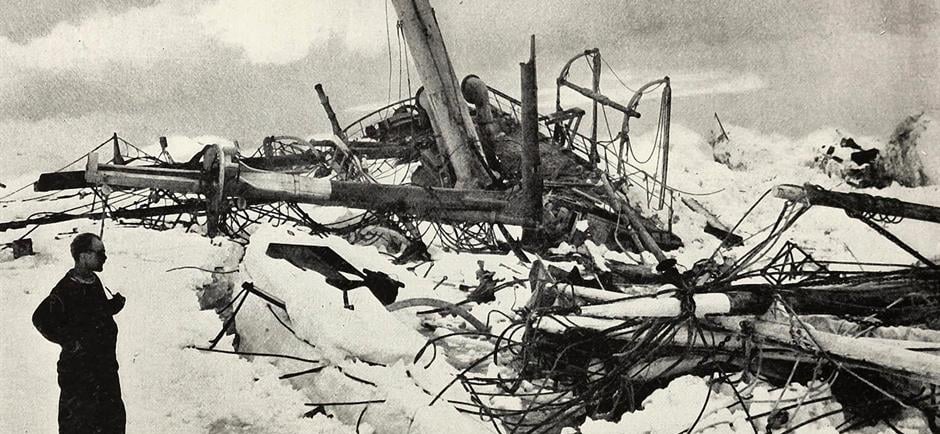
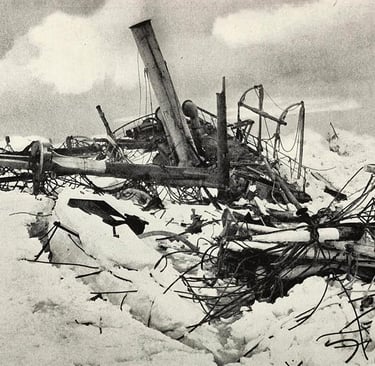
A photographer, Frank Hurley, was also present on this ship with his camera. These photos were taken by him then.
In these you can clearly see how the ice surrounding the ship, was crushing it. On 30th September 1915,
cracks were visible on the ship. But the crew hadn't lost hope. On 24th October 1915, at 6:45 PM,
suddenly, due to the immense pressure,
the ice sheet broke apart and one of the pieces hit the ship. A heavy piece of ice broke Endurance's stern post,
and water began to seep into the ship. The crew members set to work immediately. They tried to pump out the water.
They kept at it for 3 days continuously. But the water was seeping in faster than it could be pumped out.
The temperature was at -8.5°C. But the crew was neither scared nor nervous.
Some of them tried to loosen the ice sheet surrounding the ship, to reduce the pressure on it. But this didn't work either.
Water kept on seeping into the ship. Quite rapidly. While the pressure of the ice on the ship wasn't decreasing.
Finally, Shackleton, gave up, and ordered the crew to leave the ship.
To de-board. Looking at the situation, a crew member, Tom McLeod, said,
that none of them would get back to their home. The ship had been stuck for more than 9 months.
On 27th October 2015, a loud explosion was heard.
When Shackleton turned back to witness something truly shocking. The ship's rear had suddenly risen 20 feet.
The rudder and stern post broke apart. The ship's wooden parts started disintegrating. And the front of the ship was filled with water.
Thankfully, the crew members had already abandoned the ship by then. After a while, the water turned into ice.
And because of this added weight, the front of the ship began sinking.
As the ship sunk, so did Shackleton's dream of crossing Antarctica by foot.
But something much precious was at stake now. Could they return alive?
The crew had no radio, no telephone, no means to contact the rest of the world.
They were stuck on an ice sheet in the Antarctic Ocean. An ice sheet floating in the water.
On this sheet, there was a big rock of ice, the crew set up their camp there.
First, they decided to check account of their belongings. What did they have with them? How much food and water did they have?
They found that they had three small boats. One sledge, with which they could move on the ice sheet.
Some important personal items of the crew, and about one month's ration. Only one month's food.
There was only a little place to sleep at night. So many had to sleep on the ice. Most of them slept close together
to avoid being frozen. It was nearly impossible for a ship passing by to find them there.
Because they were in the Antarctic Ocean. No other ship ventured there. It had been over an year since they last saw other humans.
The rest of the world didn't even know for sure if they were alive or not. Neither could they send any messages. Nor did they expect any help.
Shackleton had only one thing. Faith on his skills and experience.
But how long could this faith keep him and his crew alive? What would they do once they used up the food?
Setting up a camp on the ice wasn't an infallible solution either. Because the ice could break at any time. They needed land.
Shackleton ran his calculations and estimations. He believed that the nearest land was the Paulet Island.
About 550 km across the icy sea. An island at the tip of Antarctica.
Ironically, in 1903, after a Swedish ship got stuck, some rescue gear was left behind on Paulet Island.
So that if another ship got stuck in Antarctica in the future, they could rely on this island for rescue.
That gear had been bought by Shackleton himself. And, 12 years later, Shackleton needed it the most.
The crew collectively decided to try to go to the Paulet Island. Carrying their stuff with them on the sledge.
And so Shackleton ordered that each person was allowed to carry only up to 2 pounds of necessary luggage.
Many of them had brought their personal items from the ship. But Shackleton reminded them that nothing was more precious than their life.
Shackleton left behind some gold coins and his Bible in the snow. The photographer Frank Hurley had taken around 400 photos.
He had the negatives of the photos, but because of the 2 pound restriction, he could carry only 150 negatives with him.
These 150 photos later presented this historical event to the world.
A few weeks later, due to the shortage of food, the puppies living with the crew had to be killed.
They had nothing else to eat.
After a few days of preparation, the goods were loaded onto boats and sledges. Each boat weighed about 1 tonne.
It wasn't easy to pull them. Fate wasn't on their side. Because by then, summer had returned to Antarctica,
and temperatures were increasing. Causing the surface of the ice sheet to became softer making it difficult to pull their luggage.
After 3 hours of hard work, when the crew looked back they saw that they had crossed only 1 mile.
The road ahead kept getting worse. Shackleton decided to camp there
until this ice sheet floated closer to land. The ice sheet on which they set up their camp,
was later named Ocean Camp. Shackleton delegated some work to each and every crew member,
so that they won't be bored or feel depressed. On 21st November 2015, the pressure on the rear of Endurance had increased so much that
the ship began bouncing on the water. It was airborne for a while,
before sinking completely under the ice.
The crew members were only a few kilometres away from the ship. They witnessed this entire incident.
Although they had already abandoned the ship, but seeing it sink like this,
left a deep emotional shock on them. As if their last link with the world had broken.
Only the ice sheet remained, and the Ocean Camp they built on it. Over the next few days, things went well.
But a few weeks later, this ice sheet started floating towards East. Further away from land.
So on 23rd December 1915, Shackleton decided to leave the Ocean Camp.
And once again, he decided to walk. But after walking a few kilometres,
suddenly, they were faced with thin ice and water. They could neither move forward nor back.
Once again, they set camp on this ice sheet. Looking at the food shortage,
Shackleton put in some strict controls. The crew was given one biscuit a day. Some diluted milk, some cocoa, and a small amount of
high-fat meat paste from the cans they were carrying. Apart from this, the crew started hunting the seals and penguins they could find.
In reality, there was a frightening food shortage, but Shackleton would often lie to his crew members about food quantities,
to keep them motivated. "Don't worry, lads." "There's enough food to keep us alive." He knew that if they wanted to survive this situation,
it would take a long time. As such, the thing they'd need the most,
was mental strength. This is true for us too, friends. To overcome most challenges,
you need to be mentally strong. In India, a living example of this is, Dinaz Vervatwala.
In 2005, Dinaz faced a crisis. There was a fire at her home. In that fire, she suffered 53% burns on her face and body.
Doctors had said that living a normal life would be difficult for her. But Dinaz turned that tragedy into her biggest strength.
After she left the hospital bed, she relied on her mental strength to make a Guinness World Record within a few years.
She surprised the world by doing aerobics for 26 hours straight. Today, Dinaz is not only a fitness trainer,
she is one of the top coaches in India for mental and physical fitness. She has trained celebrities including Olympic medallists and Bollywood stars.
Including many famous people. Like Saina Nehwal, Pullela Gopichand, actor Chiranjeevi, and Chandrababu Naidu.
But why am I talking about Dinaz suddenly?
Eventually, a new year begins. And in the morning of 23rd March 1916,
Shackleton could see something beyond the fog. As the fog cleared,
they could see mountains. Shackleton recognised it as the Joinville Island. But being about to see Joinville Island wasn't that great.
Because this island was located at the very tip of the peninsula. It meant that they had floated so far on the ice sheet that
they had left Paulette Island behind. Joinville Island was only 57 miles away from Paulette Island.
But in the west, at a 90-degree angle, there was a lot of ice in the middle. It was nearly impossible to cross this ice.
So, Shackleton went back to his map. He could see that if they continued floating towards north,
there would be only two more islands on the way. Clarence Island and Elephant Island. After this, there would be nothing but water for thousands of kilometres.
An ocean with waves so high, that the chance of their survival would go down to almost zero.
The water between the southernmost tip of South America and the northernmost tip of Antarctica is called the Drake's Passage.
It is the most dangerous water body in the world. With waves as high as 12 metres. More than 20,000 sailors have lost their lives
in Drake's Passage. And over the years, there have been at least 800 ships, that have sunk in this Drake's Passage.
Friends, even now in 2025, if you try to cross this passage on a ship,
you will see such scenes. The Drake's Passage rocks even the biggest cruise ships.
So yes, Shackleton knew that if they reached Drake's Passage floating on the ice sheet,
they would all die. Meanwhile, the food shortage had become severe, The waste meat scraps that had been set aside for the dogs,
humans had to now eat the less smelly bits. To get drinkable water,
everyone would hold a small can filled with ice close to their bodies to melt the ice using their body temperature,
to get some clean water to drink. But in these can, they could collect only a few tablespoons of water at once.
An interesting fact here was that although there were 28 people in this crew, officially, they were supposed to be only 27.
In August 1914, when this ship departed from Britain, the 28th person, Blackborow, hid in the ship.
Shackleton had already refused to add Burrow to this crew.
But still, he came on board secretly. Later, when he was found out, Shackleton told him directly,
that if they even ran out of food, he would be the first human they'll eat. Friends, you'd remember the Miracle of Flight 571,
the survivors of that flight had to resort to this. A shocking and painful thing to do.
Many people would rather die than do this. But thankfully, Shackleton's crew didn't have to go this far.
They were lucky to have spotted a sea leopard one day. They hunted it, to get about 1,000 pounds of meat.
Apart from this, many crew members killed their dogs to be eaten. After this, thankfully, for the next few months, there was no shortage of food.
7th April 1916, floating on the ice sheet, the crew finally spotted Clarence Island.
They estimated that it was about 83 km to the north. This island renewed their hope.
But then suddenly, the wind changed direction. The wind started blowing eastwards.
There were no islands in the east. There was no land. In a few hours, Shackleton and his crew lost all hope.
The ice sheet on which they had set up their camp, was getting smaller.
By this point, it was only 50 meters long. It was getting dangerous for the crew to remain on this ice sheet.
So, Shackleton decided to load the crew members in these three boats, and move forward towards Clarence Island.
Not only did they have to wade through water but also other ice sheets and icebergs.
Some way ahead, they came upon another solid ice sheet. There, they set up a new camp.
But as soon as they set up their camp, a crack started forming on this ice sheet.
And accidentally, one of their crew members fell into the water. That was Fireman Ernie Holness.
The rest of the crew tried to get him out of the water quickly. But before they got the chance to catch their breath,
this ice sheet broke apart into two. Shackleton was left alone on one part,
and the rest of the crew was swept away into the darkness on the other part. No one knew what to do.
Their leader, their commander who had been leading them for so long, suddenly disappeared into the darkness.
Luckily, they heard Shackleton in the darkness. "Bring a boat."
After this, some crew members brought Shackleton back on a boat. After reuniting with his crew,
Shackleton asked about Holness first. He was shivering a lot. After falling into the water, the risk of hypothermia increased.
There was no way to light a fire. If nothing could be done, he would die shivering.
Shackleton used his skills and experience once again and ordered him to keep walking until
his body heat could dry the clothes on his body. This poor boy kept walking the entire night.
And eventually, this helped dry his clothes. He stopped feeling abnormally cold.
Meanwhile, the wind kept changing its direction repeatedly. The ice sheet would go one way and then another.
They changed their target four times. First, they believed that they would reach Clarence Island. Then they thought they would reach King George Island.
They even thought of Hope Bay. And finally, they decided to go to Elephant Island.
Elephant Island is the last island before Drake's Passage. It was 160 km away from them to the north-west.
Since the iceberg was already moving northwards, the temperature was getting warmer slowly.
The temperature had reached -8°C. The ice cover around them was getting lighter. But on the other hand, it also meant that
fresh water supply was decreasing. They had almost run out of water. Everyone's lips were swollen and chipped due to thirst.
Their throats were so dry that it was difficult to swallow food. Everyone was given raw seal meat
so that the blood would make it easier to swallow. Meanwhile, their ice sheet was slowly floating towards Elephant Island.
They were only 50 km away from Elephant Island. Shackleton ordered all boats to be brought down into the water
this last leg of their journey would be on boats. On 15th April 1916, the crew could not believe their fate.
The three boats reached the island safely and after being on water for 497 days,
the crew members were finally standing on land.
"Having been through hell, this desolate, uninhabited, lump of rock,
seemed nothing short of heaven." They couldn't believe that their feet were actually on solid ground.
And not on ice. Everyone was ecstatic. But they didn't know that their problems weren't over yet.
The legs of Blackborow, one of the crew members, had stopped working. Another crew member, Rickinson, suffered a heart attack after they reached the island.
But somehow, he still survived. The biggest problem was that Elephant Island was completely uninhabited.
No humans lived there. Neither did it have rescue supplies nor a way to contact others.
This island was located in a place where no one went. No ship passed by.
Their problem remained the same. How could they get back home? Looking at the map, Shackleton saw three options.
First, going to Cape Horn, South America's southernmost tip, about 800 km to the north-west.
Second option, going to the Falkland Islands, about 880 km away to the east of South America.
Or the third option was to get help in South Georgia Island to the north-east,
1,300 km away. Options 1 and 2 were closer. But going there meant traversing through Drake's Passage.
Shackleton chose the third option. He believed that the sea and the air would support them more
if they went to South Georgia Island. The crew was so exhausted that it was not possible to bring everyone along.
Shackleton decided to take a small team of five to go to South Georgia by boat.
Once there, they will ask for help from a ship. And the team stranded on the island will set up their camp on Elephant Island.
On 24th April 1916, Shackleton and his team of five people,
set out for South Georgia Island. If you look at their planned route on the map,
you will see that they cannot avoid Drake's Passage completely. They would need to cross Drake's Passage to reach the island.
But there was no better option. In this small paddle boat, they entered the world's most dangerous water body.
To travel such a long distance, they would take turns to row the boat for 4 hours
and rest for 4 hours. But how well could they rest in this small boat? Their journey was spent getting drenched by the waves, vomiting, and being exhausted.
In April, winter begins for Antarctica. The sun would be in the sky for a few hours only.
And they'd be in the dark for more than 20 hours. These few hours of sunlight were crucial.
Because on then could they use their sextant to navigate the direction.
Whether they were sailing towards the correct direction. They kept sailing for hours.
Hours changed into days. On the way, water would get into their boat. And they'd pump it out.
A few times, there were such big waves that it almost sunk the boat.
For a while, it seemed like the boat wouldn't survive. But by chance, they survived and kept moving forward.
They had some food with them in the boat. But there was a problem. There wasn't enough space on the deck for them to sit up straight and eat.
That's why they couldn't swallow the food properly. So they had to lie down to eat.
The condition on this boat was so difficult that Shackleton's courage was slipping away from him.
It was getting too difficult for him. When a bird started to circle their boat,
he started shouting at it in anger. This pent up frustration was eating at his courage.
But eventually, after sailing for days, they were close to their destination. They were only 3 miles away from South Georgia Island.
But before they could celebrate, there was a sudden sea storm. Their boat was stuck in this storm.
The waves got uncontrollable. The boat kept bouncing and crashing.
These people had no more strength. They put their paddles and gave up.
The storm kept throwing their boat this way and that. A few hours later, when the winds calmed down,
and the clouds started to clear, they saw the South Georgia Island.
There was only one mile left to go. Seeing this island, they used all their remaining strength
all of them started paddling. The waves were quite strong still. Shackleton started feeling that
the end was near. The boat felt stationary. But in reality, slowly but surely,
they were moving closer to the island. After fighting with the storms, winds, and water for three consecutive weeks,
finally on 10th May 1916, they set foot on the South Georgia Island.
The same island from which they had set out on their journey to Antarctica 522 days ago.
A wave of happiness ran through them. Shackleton and the crew members hugged each other.
But this wasn't the end of their struggles. Actually, friends, the South Georgia Island is more than 100 km long.
The beach they had landed on, was on the other side of the human settlement.
Let's find the place where they landed on the map. The human settlement and the whaling station
were exactly on the opposite side of this island. They were now faced with two ways to get to the whaling station.
First, getting back on the boat and travelling 130 miles by sea,
to get to the north of the island. And the second option was to walk to the north of the island.
They had to walk only 29 miles. But the problem was that there are such dangerous mountains on South Georgia Island
that no person in history had been able to cross this island on foot.
It was considered impossible to cross this island on foot. So, obviously, they chose the boat.
But, of course, there was yet another problem. Their boat had been so badly damaged by the rough waves that
it wasn't in a suitable condition. They had no other option than to walk.
"The alternative was to attempt crossing the island. The island of South Georgia had never been crossed by anybody.
The whalers regarded the country as inaccessible." Shackleton was not one to give up now.
Not at this point. They had endured so much over the past year, they couldn't give up now.
To survive, they were now faced with a challenge no human had ever attempted before.
These 10,000-foot-high snowy mountains had to be crossed some how.
Shackleton decided to first rest and build back their lost strength. So they stayed in a cave and ate for the next 9 days.
Thankfully, there was no shortage of food on this island, the island was swarming with albatrosses, seals, and penguins.
After resting for 9 days, on 19th May 1916, at around 3 AM, they set off from the King Haakon Bay.
He had only two other crew members with him, Worsley and Crean. "Worsley and Crean were coming with me.
And after consultation, we decided to leave sleeping bags behind, and make the journey in very light marching order."
And now their first challenge was that no one knew where to go and how.
The snow was up to their knees. The mountains were so high that they couldn't see beyond them.
They climbed the mountains one after another, and looked for the way from the top. If they couldn't find a way, they would go back.
This happened several times. They climbed as many mountains as they could see. On some mountains, they found deep gorges and on others, walls of rock.
Whenever they couldn't find a way to go ahead, they retreated and got back down, to climb another mountain.
"With the complete clearance of the mist, we saw, to our sharp disappointment, what we had taken for a frozen lake,
was an arm of the sea. Shackleton said grimly, 'We shall have to go on to the next, boys.'
This happened three times." Over the next few days, they had climbed all the surrounding mountains.
Even after climbing the last mountain, they couldn't find anything new. They were staring at a deep valley. With a steep and dangerous slope.
"The situation looked grim enough; fog had cut off our retreat, darkness covered our advance.
it was useless to continue in this fashion." By then, they couldn't retreat any more. They tied themselves along a rope
and started cutting stairs into the mountain. Literally, they made stairs to climb down the mountain.
After descending for some time, they spotted the Stromness Whaling Station. And other humans!
After climbing the mountains for 36 hours, on 20th May 1916, Shackleton, Worsley, and Crean
successfully crossed the Allardyce mountain range and reached the Stromness whaling station.
It was the first time in history that someone had crossed the South Georgia Island on foot.
The level of impossible feat they achieved can be understood by after Shackleton, this was done only in 1955.
By expert climbers with full preparation. Shackleton had neither tents nor sleeping bags.
They had courage, determination, and a strong will. When Shackleton and his companions finally reached the whaling station,
it was difficult to identify whether they were humans. Their beards had grown too long.
Their faces were dark. With only their eyes visible. Their clothes were all torn.
Eventually, the factory manager at the station recognised them, and identified him as Shackleton,
the guy who had gone missing with his team in Antarctica two years ago. Every person at the South Georgia station
knew Shackleton and his crew's story. Everyone knew about it as a painful incident.
The man who died with his ship. They couldn't believe that the same man was standing in front of them two years later.
The factory manager gave them food and new clothes immediately. And a bed to sleep in. The three bathed and shaved.
And the next day, Worsley arrived at King Haakon in a boat to rescue their three other companions.
The three people who were still waiting for Shackleton on the other side of the island. But Shackleton's real concern now was
the 22 crew members stranded on Elephant Island. It had been more than a month since they last saw them.
Were they still alive? In such dire situation, would you be able to remain motivated enough to survive?
Especially when you don't even know if your Captains could successfully cross Drake's Passage or not.
On the other hand, will anyone come to rescue you or not?
Shackleton tried his best to rescue them from Elephant Island as soon as possible.
But when he reached there with another ship, once again, the rescue ship got stuck in the ice.
He tried again, but it didn't work. The same thing happened the third time. In three months, he tried thrice to go to Elephant Island to rescue them.
But he had to turn back his ship all three times. As time passed, Shackleton's kept getting more and more worried.
He specially requested the British government to give him an ice-breaking ship. He was given a ship called Discovery,
but it would have taken some more weeks to arrive. Shackleton was in no mood to wait.
He didn't know how long would they be able to hold out.
Another ship was requested from the Chilean government. He was given a ship named Yelcho.
On 25th August 1916, he left for Elephant Island again aboard this ship.
It took him about 6 days, but this time, he reached Elephant Island successfully on 30th August.
He was shocked by what he saw when he reached the island.
Actually, these 22 people who remained on Elephant Island, Shackleton knew that they would need leadership.
Or else, they would get depressed and frustrated. So, Shackleton made one of them, Frank Wilde, the leader.
After Shackleton left, on Frank Wilde's orders, they built a shelter by turning over the two boats.
They remained there for 128 days. They used to hunt penguins and seals to feed themselves.
Amidst the cold, hunger, and disappointment, Frank Wilde repeated the same thing every morning. 'Pack your bags, friends.
The boss can come today.' Boss referred to Shackleton. But the boss didn't come. Days changed into weeks and weeks into months.
But every morning, Frank would get up and repeat the same thing. 'Pack your bags, friends. The boss can come today.'
Every morning, Frank climbed the hill to check whether a ship arrived or not. And every evening, he returned disappointed.
After four months, people's courage was beginning to wane. Things were getting more difficult. Blackborow's leg was grossly infected.
It was a gangrene infection. So they had to cut off this leg.
With every passing day, they were closer to believing that Shackleton couldn't actually reach South Georgia.
His boat might have sunk on the way.
It had been 4 months and 6 days since Shackleton left. Frank Wilde had decided to move ahead.
At Frank's order, they really packed their bags. But not in the hopes of being rescued,
this time, they were planning to sail. They started preparing to leave for Deception Island.
But before they could leave Elephant Island, they spotted something far in the sea.
A huge ship was sailing towards them. This was the ship Yelcho.
Once the ship was close enough, they could see their commander and boss, Shackleton. "From the man on duty outside, we heard a sudden yell.
'Wilde,' he shouted, 'Wilde!' 'There's a ship!' 'Haven't we better light a flare?'"
Their boss was finally there to rescue them. Shackleton was stunned to see them.
All 22 of them were alive. They hadn't given up. After fighting with ice, mountains, and oceans for almost 2 years,
Shackleton and his crew returned home. "When we landed, they welcomed us so heartily,
that they nearly pushed us into the sea again."
It was truly miraculous. Shackleton left with 27 people. And returned with all 27 people
It was possible only because of Shackleton's leadership and courage, the determination of the crew, and their unbreakable teamwork.
Friends, 106 years after this incident, in 2022, investigators were doing some research in the sea.
Then, in the Weddell Sea, 10,000 feet below the surface, they found Shackleton's ship, Endurance.
"The state of preservation is just absolutely brilliant. There are no wood-consuming marine parasites in the Weddell Sea."
It's truly amazing that it took us 106 years to find the wreckage of this ship. And even after 106 years,
since it sunk so close to Antarctica, it is in remarkably good condition. You can see the latest photos of this ship on the screen,
these were taken a few years ago. And today, if you ever go to South Georgia Island, you will find Shackleton's grave there.
He set out to accomplish a historic feat. To be the first man to walk across Antarctica.
Although his original plan failed, he did something even more miraculous.
Much more amazing.
Friends, if you liked this survival story, then an equally amazing survival story is of
the survivors of Flight 571. Another story that tells you that if you have determination, courage, and a strong will
you can make the impossible possible.