Why India's Air is So Deadly
And Getting Worse!
4/23/202522 min read
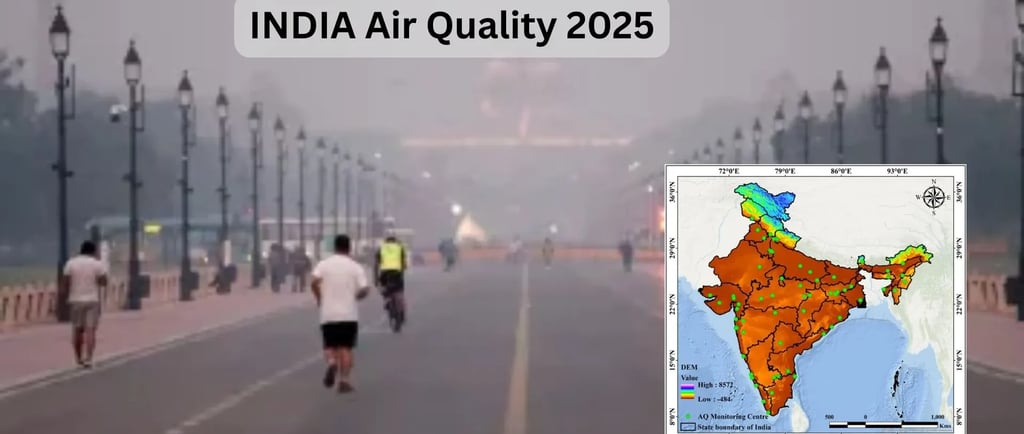
"April marks the beginning of summer." "But at least the air is cleaner now." "No." "In our country, people talk about air pollution only when," "the AQI cross 500 during winter." "And even then, media is focused mostly on" "firecrackers and stubble burning." "But IQAir's latest report last month" "reveals some shocking data." "As per Indian standards," "if the air quality is Moderate," "and represented by Yellow," "the same air, as per European standards." "will be classified as Extremely Poor," "and symbolised with Dark Red." "Are people being fooled here?" "The PM2.5 particles" "are 1/30th the width of a strand of hair." "They reach our lungs when we breathe." "Through our lungs, to our bloodstream." "From there, they reach our hearts." "And increase the risk of heart related diseases like strokes." "The effect of PM2.5 particles on children" "are the most devastating." "Compared to their body weight," "they breathe in more air." "Surprisingly, whether it's Delhi or Mumbai," "Kolkata or Bangalore," "apart from a few regional differences," "all across our country, air pollution is" "caused by similar root causes." Hello, friends! Can you guess which is the most polluted city in the world? If you said that Delhi is the most polluted, you're wrong. You'd think that it would definitely be a North Indian city. Some place in Haryana, Uttar Pradesh or Bihar. But no. So the next logical answer would be some African or Chinese city. No. Friends, what's surprising is that it is an Indian city, lying in Northeastern India. A region of our country that is known for its green, lush forests and clean lakes and rivers. But here lies the small city, Byrnihat, on the border of Assam and Meghalaya. According to the 2024 IQAir report, it has been ranked as the world's most air-polluted city. If you study this report properly, you'd find many such shocking facts. Many people believe that air pollution happens only in winter. Or that it is only a problem in North India or Delhi. But the truth is that it affects our entire country, from Kashmir to Kanyakumari, all cities from Mumbai to Kolkata, from Chennai to Bangalore, throughout the year, 365 days, 24x7, it remains a dangerous and deadly problem. On IQAir's website, there's a list of about 9,000 small and big cities from all over the world, which have been sorted to find the most polluted cities. When you scroll through it, you will see that there are many Indian cities on the list. You can see only 50 cities at a time. So let's go to the next page. And the one after that, the fourth page now, Just look at the sheer number of times you can see the Indian flag. The truth is that, almost the entire population of 1.4 billion people living in the country, are breathing in such an air that does not meet the standards of the World Health Organisation. It's also surprising that the reasons behind this air pollution though there are definite regional differences as to their causes, but the root causes all across the country, are similar. let's do a detailed analysis, on the exact causes of air pollution. And what are the exact steps that need to be taken to clean this air? And how well are the actions taken by the governments being implemented? Friends, many of you might feel that summer is just beginning, it's the season of clean air. So it makes no sense to talk about air pollution now. But I want you to open your weather app. There's an AQI indicator, click on it and scroll down. You will get the exact reading of PM2.5. It is measured in terms of micrograms per meter cube. Comment below with this reading. What's the PM2.5 level where you live? According to the World Air Quality Report 2024, on average, throughout the year, India's air quality contains 50.6 micrograms per meter cube of PM2.5. For some of you, it will be around 60-70. For some, it will be 40. And for some, it may even be 30. But what do the World Health Organisation guidelines say about it? The level of PM2.5 should be less than 5 micrograms per metre cube. In terms of the annual average. And I can confidently say that, 99% of you are breathing in air that does not meet this safety level. Even though it is summer, stubble burning hasn't started yet. And even if you don't live in North India. A major reason behind this is that we have normalised the toxic air in the country. Many people think that if the AQI is between 150-200, the air is clean. That's not your fault. Because according to Indian standards, this level of AQI is given a Moderate rating. It's colour-coded Yellow. But did you know that the guidelines made by our government and the guidelines made by the WHO, are vastly different? When I found out about it, I was shocked. Look at these three tables on the screen. The first table shows the air quality standards of India. If the PM2.5 is less than 30, then it is categorised as Good and represented by Green. Even if PM2.5 is as high as 90 micrograms per metre cube, then it is categorised as Moderate and represented by Yellow. But according to the WHO, the Safe level of PM2.5 is only until it is below 15 micrograms per metre cube. And the European guidelines are even stricter. Only PM2.5 concentration below 10 micrograms per meter cube is considered to be Good Air. Once it goes above 20, it's considered to be in the Medium and above 25 it falls into the Poor category of air. Do you see the difference? If the PM2.5 level gets to of 75 micrograms per meter cube, according to the European rating, it will be colour-coded in a dark red colour. And will be considered Extremely Poor Air. But according to the Indian grading, it's only Moderate air. Here, it will be represented in Yellow. But the problem is so extreme that even if we consider the Indian standards, there was not a single day of 'Good Air' in Delhi throughout 2024. For it to be considered 'Good Air', the AQI should be below 50. In 2024, the best AQI was measured on 8th August at 53. While talking about air pollution, I've been using the word PM, its full form is Particulate Matter. These are minute particles present in the environment. Microscopic solids or even liquid droplets. They are divided into three groups based on their size. The largest are PM10 particles. Their size is 10 micrometres or less. These usually include dust particles or pollen of flowers. The second category is PM2.5, for pollutants whose size is 2.5 micrometres or less. They are so small that if you compare them with human hair, as you can see on the screen. their diameter is almost 1/30th of the hair. And the third category is PM0.1 for pollutants as small as 0.1 micrometres or less. They are also known as Ultra-Fine Particulate Matter. They are the most dangerous because when you breathe, they can travel through your lungs and reach your bloodstream, that's how small they are. One simple thing to remember about all these PM particles is that the smaller the particle, the more dangerous it is. When you breathe in through your nose, most of the PM10 particles stick to your nose or throat. These cause inflammation, infection, sneezing, and coughing fits. This is how our bodies filter out these particles. It is our natural defence system. But for fine particles like PM2.5, this defence system doesn't work. And they can easily reach your lungs, where they cause swelling, increase the risk of asthma, bronchitis, as well as an increase in the risk of getting lung cancer. But do you know what's worse? Treating pollution-related diseases is very expensive. Getting admitted to a hospital with lung infection can cost ₹5 lakh to ₹10 lakh. Are you financially prepared for this? Because medical emergencies don't come announced. The come and take away the entire family's savings. People don't even know when this ₹5-₹10 lakh turns into ₹40-₹50 lakhs. This is why a health insurance is necessary for you and your family. They start at only ₹300 per month. It can protect you against these huge medical bills. Many people rely on the health insurance provided by their employers. But most of the time the coverage is around ₹3-₹4 lakh only. And numerous other restrictions. And when you change your job, that insurance becomes ineffective. That's why it's important to have one health insurance plan for your family. Make sure that it has a bigger cover, rider options, and timely claim addressal. Getting back to these PM particles, these fine particles travel through your bloodstream and reach your heart as well. This increases the risk of heart attacks and other heart diseases like stroke. Nowadays, we frequently hear about 30-40 year old people getting heart attacks and strokes. Even though they didn't smoke, had a healthy lifestyle, used to go to the gym, etc. This could be a major reason behind it. According to some studies, these PM particles can even reach the brain where they cause neurological and mental disorders. These particles can be anything. Bacteria, viruses or smoke. When we talk about PM particles in the context of air pollution, we are talking about the pollution-causing particles specifically. Like smoke. The smoke emitted when something is burned. Or the PM2.5 particles of black carbon. According to a study by the Swedish Karolinska Institute, between 2009 and 2019, due to the high levels of PM2.5, across the country, around 3.8 million to 16.6 million people died. This range is so wide because if we consider the Indian standards, then the number will be at 3.8 million. But if we go by WHO's air quality standards, then the number of total deaths will be 16.6 million. Think about it, if the sole provider of a family meets such a fate. What would the family go through? You need to think about your family's future in case of such a situation. To secure your family's future even during your absence. This is where you need to consider term insurance. This is as important as the health insurance. Term insurance is the purest form of insurance. And the plans begin at only ₹600 per month. You can get coverage for even crores. The sooner you take a term insurance the lower would be the premium, that's bascially locked for the entire tenure of the insurance. Do not delay such important decisions. No matter which insurer you choose, the point is that both these insurances are crucial. You can use the link in the description to compare insurance plans of trusted insurers. And purchase them at an online discount of 15%-25%. Secure your family against such emergencies. Today, insurance isn't an option, it's a necessity. Here, let's thank Policy Bazaar for sponsoring this video. Now, let's get back to the topic. According to a study by The Lancet, 7.2% of the deaths in 10 Indian cities were caused by the high levels of PM2.5. In these 10 cities, more than 33,000 people die every year due to air pollution. Despite all this data, the Environment Minister in the Modi government, Kirti Vardhan Singh told the Lok Sabha that there's no conclusive data to prove the direct link between air pollution and deaths. Look at the Chicago University's Air Quality Life Index report from August 2023. According to it, exposure to PM2.5, has shortened the lives of Indians by 5.3 years. In Delhi, this number was at 11.9 years. And in the plains of North India, it was 8 years. That means if your natural live could have been as long as 80 years without air pollution, because of this air pollution, you'll live only 70 years. Children are affected by this the most. In pregnant women, air pollutants affect the development of the child in the womb. Organs like lungs and heart remain underdeveloped. It also increases the risk of premature birth or the child's death during delivery. Often, because of this, children are born with heart defects. Because of this, they can't live for a long time after delivery. According to the State of Global Air Report, 2020, in 2020, air pollution caused the deaths of 116,000 babies in India within 27 days of birth. This means that in India, every 5 minutes, a newborn child dies due to air pollution. Even after birth, children are more affected by air pollution than adults. And there are scientific reasons behind it. Compared to their body weight, children breathe in more air than adults. Apart from this, children spend more time outdoors, do more physical activities. And because of this, they breathe in more polluted air. Dr Arvind Kumar is a chest surgeon. He says that nowadays when he operates on children, he can see black deposits in their lungs. And now, more and more lung cancer cases are caused by air pollution rather than smoking. While talking about air pollution, it cannot be denied that there's a clear divide between North India and South India. Air pollution is much worse in North Indian cities as compared to South Indian cities. Geography is one of the primary reasons for this. In North India, during winters, the atmospheric thermal inversion process is underway. This is a natural phenomenon that occurs in winter. At night, everything is quite cold. And then when the sun rises in the morning, it hits the air at the top first. This heats the upper layers of air. This hot air settles on top of the colder air and the colder air that's closer to the ground remains there at ground level. And the PM particles mix with the colder air and stay near the ground. They don't easily get the chance to rise up into the air and get blown away, as they do in other seasons. The second geographical problem is due to the Himalayan mountains. The Himalayan Mountains act as a natural barrier over the entire Indo-Gangetic plain. Because of this, air cannot flow past it. Experts call this the Valley Effect. Due to the cold, the speed of the airflow decreases too, and once again, the pollutants remain trapped there. The same phenomenon is seen in Northern Italy too. The Alps mountain range in Europe, form a natural barrier just like the Himalayas. And the valley at its southern base, in Northern Italy, the air remains trapped there. There's thermal inversion too. And this is why during winter, if you compare this region with other European regions, there will be higher pollution in Northern Italy. This doesn't happen in South India. In fact, South India has a geographical advantage. It's surrounded by seas on three sides. Because of these seas, air can flow easily from one place to another. The pollutants that are emitted is easily blown away in the wind. And it doesn't get very cold either. All this combined means that there's no thermal inversion. This is perhaps the biggest reason why the cities in the southern half of India, have relatively cleaner air than in the northern half. Delhi's annual average PM2.5 concentration is 108 micrograms per metre cube. Kolkata's is at 45.6 and it's quite evident here, at Mumbai it's 33.7, at Bangalore it's 30 and 26 in Chennai. But it's only relatively cleaner. Because WHO's guideline says that this should be lower than 5. Even in Chennai, which has the most geographical advantage, it is still 5 times the safe level. So the question arises, what is the exact reason behind air pollution? The first and biggest reason is vehicular pollution. All the vehicles, buses, trucks, and two-wheelers running on petrol and diesel, produce a poisonous cocktail of carbon monoxide, nitrogen oxides, and hydrocarbons. In every big Indian city, these vehicles are the biggest villains in turning the air poisonous. If we talk about Delhi, about 47% of PM2.5 pollution is caused by vehicles. Think about it, if all the vehicles in Delhi disappear, the air pollution will immediately be reduced to half. In 1998, the number of registered vehicles in Delhi was about 3 million. By 2019, this number had increased to more than 12 million. This is the main reason for the year-on-year increase in pollution. The government created various emission standards to tackle the pollution caused by vehicles. In 2020, the government introduced the BS6 emission standard, which reduces the PM pollutant emission from a vehicle. As per this, the latest technologies are used in vehicles to reduce pollution. For example, in BS 4 standard, the PM limit was 25 mg per kilometre. But in BS 6 standard, this limit was reduced to 4.5 mg per kilometre. To remove the vehicles made as per the older standards from the roads, the Supreme Court imposed a ban that in the NCR region, vehicles older than 15 years would not be allowed to run. Apart from this, Nitin Gadkari is talking about introducing BS7 standards soon. These are good initiatives but there are two problems. First, the faster the number of vehicles in our cities increases, the pollution caused by them is much higher than compared to the reduction in pollution by improving the emission standards. And the second is that, in cities, government's actions are increasing car dependency. Expanding roads, building wide highways, and flyovers. This means there's less space for walking and public transport. And even those who don't want to use cars are also being forced to travel by car. Take Mumbai for example. In 2016, vehicles were responsible for only 16% of pollution, now this figure has increased to 30% because of car dependency. Compared to walking, cycling, and using public transport, cars occupy a lot more space. If more people travel by car, there will be more traffic. This is happening in our cities. When a company from the Netherlands issued a list of the most traffic-stricken cities, Kolkata was in second place. It takes more than 34 minutes to travel 10 km. Because of the traffic. Apart from this, Bengaluru, Pune, Hyderabad, and Chennai were also mentioned in this list. The solution to this problem is quite clear. Instead of spending money on roads and highways, the government needs to spend on public transport. In cities, metro, buses, trains, and trams need to be promoted. When I suggested this in a previous video, some people made fun of it. Claiming that I am against spending money on highways. But you'll be shocked when you see the data. According to a report by the NITI Aayog, there are only 1.2 buses for every 1,000 people in India. In developing countries, this is around 5. And in developed countries, there are more than 10 buses for every 1,000 people. Between 2000 and 2009, the number of government buses in Delhi increased only by 1%. But the number of cars increased by 9%. According to the Center for Science and Environment study, the share of public transport which was at 75.7% in 2000-2001 will decrease to 44.7% by 2030-2031. This means that the use of public transport is decreasing in our country. This isn't good news. In India, today, out of every 1,000 people, 246 people own vehicles. And this is the state of air pollution in the country now. Can you imagine what will happen over the next 10 years? Because of the crowd, long waiting times, unreliable services, etc., people avoid travelling by public transport. All governments urgently need to address this. They need to improve train and bus services. Because if we don't do this now, air pollution is going to get worse over the next 10 years. Today, if you look at any developed country, which has cleaner air and equally high population density, whether it's China, Japan, South Korea or Singapore, despite the high population in all these countries, how can the air remain clean? Because these countries offer excellent public transport facilities. These countries impose high restrictions on driving cars. In Singapore, there's even a total limit of the number of cars on the roads. Now let's come to the second biggest reason which is quite interlinked with vehicles. Dust. Whenever someone drives a car or rides a bike on the road, a lot of dust is blown into the air. This is known as the Synergistic Effect. When two factors come together to create a greater effect. The dust on the road is responsible for 26% PM2.5 pollution in Delhi. This happens because of the potholes or the unpaved roads. In Kolkata, the dust from the road makes up 25% of PM2.5. This number is 23% in Bengaluru as well. This type of pollution is seen more in areas that sees more traffic or infrastructure projects. And usually, this happens more in dry winters. In cities, this dust is often visible as haze. You can see it in these photos. This dust along with the emissions from vehicles become even more dangerous. To reduce this impact, you must have seen news about using how anti-smog guns. Or spraying water. When there's a lot of pollution in winter. By doing so, water is sprayed into the air, which then carries the dust back to the ground. This can be a temporary solution. But the long-term and proper solution is to have the right infrastructure. Paved roads with proper footpaths, green belts beside them, that has grass and other plants for greenery. Apart from this, potholes must also be filled to tackle pollution. The third biggest cause is construction work. 20%-30% of the air pollution in our country, is caused by construction. In Delhi, the construction sector contributes 8.4% of PM2.5. In Mumbai, it contributes 9% of the total PM. These construction sites release dust particles mixed with cement, sand, and other construction materials into the air. An average construction site generates around 300 kg of dust every day. In Delhi, construction activities are often completely banned when the air quality reaches dangerous levels. But once again, this is a temporary solution. And the real solution is the implementation. To control the air pollution caused by any construction site, it is necessary to install dust and wind-breaking walls all around it. There are regulations about it in our country. But these regulations are often not implemented. At most construction sites, let alone these walls, they put up a small sheet just for formality. Apart from this, trucks carrying sand and cement release so much dust when they travel to and from construction sites. The rules say that these trucks should be completely covered up before leaving the site and their wheels should be washed. But these rules remain on paper. The governments need to implement it strictly. The fourth cause is stubble burning. Where the dry husks are set on fire. This is talked about the most in the media. But the air pollution caused by this isn't as much as you would expect. According to the Central Government, in 2024, in the months of October to December 10.6% of the air pollution was by stubble burning. On 8th October, stubble burning had the highest contribution at 35%. But this number isn't so small that it can be ignored. This is a significant cause and it is very important to work on it. In winter, farmers of Punjab, Haryana and Western Uttar Pradesh burn the leftover husks and residue crops. Why do farmers burn these crops? The answer to this is the water crisis. Before the Green Revolution in the 1960s, rice wasn't grown much in Punjab. Rice was grown on only 7% of agricultural fields. But to address the grain shortages, the government promoted the Green Revolution, and started promoting rice. The government told the farmers to grow only two crops, wheat and rice. The positive impact was that within a few years, our country became self-sufficient in terms of grain production. But its negative impact was that this Green Revolution proved to be a huge disaster for our environment and ecology. The reason was that rice needs a lot of water to grow. Initially, the government promoted bore wells for this. The use of groundwater. But because of this, the groundwater levels started decreasing in Punjab. When the risk of groundwater depletion got serious, the government came into action. In 2009, the Punjab government passed the Punjab Preservation of Subsoil Water Act. According to this, the farmers were told to grow rice only at the beginning of the rainy season. So they wouldn't need groundwater. They'd need only rainwater. But then this led to shifting the planting season for rice from May to June. Delaying planting rice by a month meant delaying the harvesting season by a month too. It changed from September to October. And so the farmers didn't get much time to plant the winter crops. After harvesting the rice, they needed to prepare their fields for the next crop as quickly as possible. And the easiest and cheapest way to do this is to burn whatever's left over. To deal with this problem, there was the Air (Prevention and Control of Pollution) Act of 1981 already. Under this Act, stubble burning was a crime. But even by imposing penalties didn't solve this problem, because it was cheaper for the farmers to pay the penalties as compared to spending money to remove the stubble. Other ways to remove stubble in a short time, like the Happy Seeder Machine, Rotavator, Baler, it's difficult for an average farmer to afford these. So there are two straightforward solutions to deal with this problem. First, the government need to provide these machines to the farmers at a low cost or for free. And second is to tell the farmers to stop farming rice and diversify their crops beyond these. They can grow crops like Millets that don't need a lot of water. But this is a separate topic in itself because this needs to talk about the MSP too. We'd need to look at the economics from the perspective of an average farmer. Will it be as profitable for them to grow millets as rice is? The second, the central government had claimed that since 2018, they have allocated ₹33.33 billion under the Crop Residue Management Programme. to help farmers and prevent stubble burning. But multiple records show us that this amount isn't enough. This money can be better utilised. State governments are constantly asking for more money for the crop residue programme. Which includes the recent plea of ₹12 billion by the Punjab government. But the Central Government rejected this plea. The fifth and final major cause of air pollution is Industrial Pollution. Industries related to chemical, textile, cement, steel, refinery, and power plants cause the most pollution. Along with PM2.5, they release sulphur dioxide, nitrogen oxides, and carbon monoxide into the air. Overall, in Delhi's air pollution, industries account for 15-18%. In Kolkata, it is at 24.5%. In Mumbai, it is at 18%. And in Chennai, it is at 20.2%. To stop this kind of pollution, strict action is needed. Like in 2017, the Supreme Court banned the use of fuels like petroleum coke to prevent pollution. The Delhi government has also taken steps to stop it. Like, there used to be three thermal power plants in Delhi. But to reduce air pollution, one of them was shut down in 2009, the second in 2015, and by 2018, the third was shut down too. Today, Delhi is the only state that has no thermal power station. Renewable electricity sources like solar power should be used to generate electricity. But the problem here is that the Delhi Government's actions alone won't make a lot of difference. Because there are many industrial regions around Delhi. Like Gurgaon, Meerut, Noida, and Faridabad. Thermal power plants and polluting industries are still functioning there. We need strict regulations on a national level to curb these industries. In January 2019, the Ministry of Environment, Forest, and Climate Change launched the National Clean Air Programme. It aimed at improving the air quality in 131 polluted cities across 24 states. For this, their target was that by 2025-26 the PM10 level be reduced to 40% as compared to the 2017-18 levels. The question is how successful was the government's National Clean Air Programme? Over the last 5 years, out of the money allocated by the government, only 64% of it was utilised. Since the beginning, about ₹105.66 billion was allocated for this, of which only ₹68.06 billion were spent. The most disappointing part is that of the money spent by the government, most of which, in fact, 67% of this, was spent merely on dust control. Like hiring people to spray water on the roads. Spraying water reduces pollution for only a few hours. But will it lead to any long-term change? It would have been better to use this money to provide those machines to the farmers. At least the pollution caused by stubble burning would have been eliminated. Only 14% of the money was used to control biomass burning. Only 12% of the money was used to control vehicular pollution. And only God knows exactly how that was used. Where did the government spend the money exactly to control the pollution caused by vehicles? And the bigger sources, like industrial pollution, only 0.61% of the money was spent to control industrial pollution. Will taking such steps bring about any real change? Not at all. The Center for Research on Energy and Clean Air issued a press release in January 2025 which stated that of the 131 cities where they wanted to reduce pollution, only in 31% of these cities was pollution reduced. In 29 cities, compared to the base level of 2017-18 the pollution actually increased. Delhi, Chandigarh, Jammu, Gaya, Muzaffarpur, Ujjain, and several other cities included. The second problem is that the government is focusing only on PM10. The PM10 particles are usually dust particles which aren't very harmful. That's why the money spent by the government is used only for dust control. But they need to focus on PM2.5. Because this causes real impact on people's health. Anumita Roy Choudhury, the Executive Director of CSE, also says that in the beginning, when the government brought the National Clean Air Programme, it was supposed to focus on both PM2.5 and PM10. But now, for performance assessment, to show itself in a better light, the government is focusing only on PM10. Here, the biggest problem is political will. People don't really care about it. And because people don't, politicians don't care either. In our country, political discourse is often dominated by religious and identity issues. We're talking about comedians and what they said. About movies, and graves being dug. Our media keeps us trapped in one insignificant issue after another and our politicians are happy about this. Because it is easier for them to focus on these issues than solving complex issues like air pollution. As a taxi driver told Foreign Policy magazine, India is split into Hindu and Muslim. This is our politics. No one votes on who will reduce pollution. Some are staunch voters of BJP because they oppose Muslims. They don't care about pollution. But people forget that this enemy does not ask about your religion. The air you are breathing, both Hindus and Muslims are breathing in the same air. When you get lung cancer, it won't verify your religion first. Air pollution impacts not only our health, but also our economy. The World Bank's report from 2024 states that every year the Indian economy suffers a loss of $36.8 billion. That's equal to 1.36% of India's GDP. Another analysis states that had there been no air pollution in India, by 2019, our economy would have increased by approx. $95 billion. This is about our children's future. In this video, I talked about figures, health risks, and government's failures. Now the question is, what should be done next? Let me list down all the solutions clearly again. We need to raise our voices and pressurise all governments to act on these right solutions. You can see the overall summary on the screen. These are the 5 main cities in our country. In each of these 5 cities, what are the exact causes of air pollution. In Delhi, about 50% is due to vehicles. 11% due to industrial sources. 7% due to construction sources. The rest of it is from the outskirts of the NCR districts. Where stubble burning plays a significant role. In Kolkata, vehicles account for 50%. Industry is 24%. Dust is 21%. In Mumbai, vehicles 30%, industry is 18%, dust 15%. In Hyderabad, dust is 32%, vehicles 18%, industries 5%, and construction 8%. In Chennai, which is the cleanest city out of the five, road dust accounts for 28%, vehicles 23%, industry is 20%, and construction 4%. And in Bengaluru, which is relatively clean too, there, industrial pollution is next to nothing. Around 50% of the pollution there is due to vehicles, 16% due to dust and 11% due to construction. So what are the solutions? First and foremost, public transport needs to be promoted on a large scale. The expenditure on public transportation needs to be at a large scale. The central government needs to do this for metros and trains, and state governments can do this for buses. But where will they get the money? The money spent to on highways being built for vehicles, can be better utilised here. Second, take off the older, polluting vehicles from the roads. Vehicles older than 15 years. These cause the most pollution, because their emission standard isn't up to the mark. The government is already planning to strictly enforce this. As you can see in this news article. Petrol pumps can refuse to sell fuel for vehicles older than 15 years. Third, the rules to cover the construction sites should be implemented. There needs to be regular checks on construction sites in the city. Fourth, governments should spend on controlling stubble burning. By providing machines like Happy Seeders to the farmers. Fifth, to control the road dust, they need to fix potholes, proper footpaths should be provided, and vacuum road sweepers should be used so that the dust doesn't blow up into the air. Many municipalities often hire sweepers to clean the streets. But this doesn't help because sweeping makes the dust go flying into the air. Next, for industries, strictest standards for emissions norms be enforced. This is the cause behind the most polluted city in the world. Industries. Byrnihat is an industrial town. Apart from this, awareness campaigns are needed for the people. About the exact causes of pollution. If you have the option, use public transport instead of using your own vehicles.