Why No One Can Climb Mount Kailash?
The Mystery Revealed
2/2/202613 min read
Back in 1999, Dr. Ans Mulda Shef from Russia arrived in Tibet with his team. They were on an expedition searching for the world’s most mysterious mountain—Mount Kailash. After weeks of exploring, when they returned to Russia, they made some claims that shook the entire world. Mulda Shef said that a few years earlier, four Siberian climbers tried to climb Kailash, but within a year and a half, all four had aged rapidly and died. One of their team members, Sir J. Selver Stof, said that Mount Kailash is like a time machine.
Time moves differently, and people age faster. A lot of folks have even claimed that nails and hair grow quicker near Mount Kailash. Dr. Mulda Shef went as far as saying that Kailash is actually hollow inside, with tons of caves where people from an ancient mythical civilization are in deep meditation. These claims went viral, and even today, if you search Mount Kailash on the internet, these stories pop up first. But how much truth is there in these claims? Does time really move differently near Kailash?
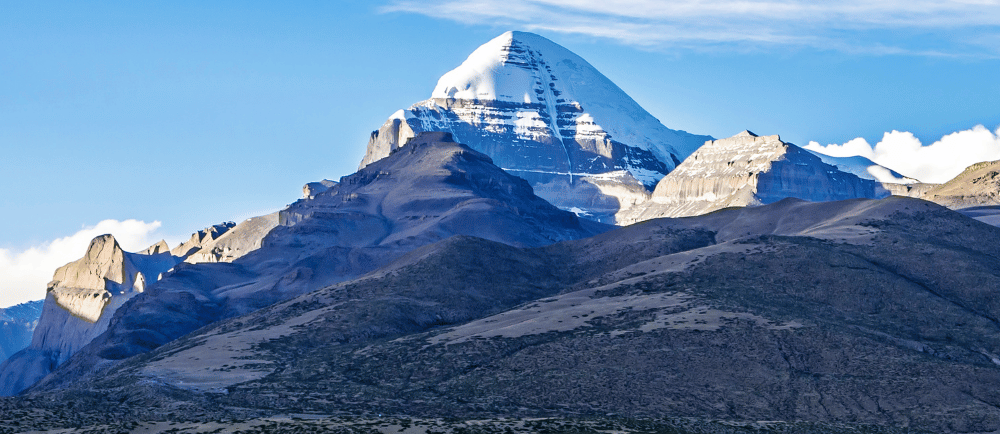
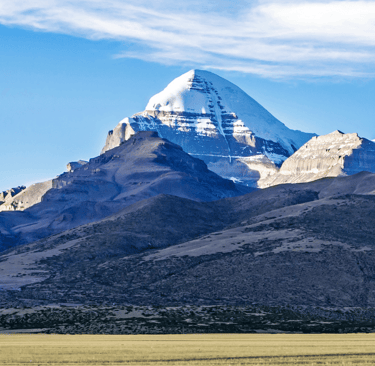
Does it behave properly? What’s the real reason that thousands have climbed Mount Everest, the tallest mountain in the world, but no one has ever been able to climb Mount Kailash? If we look at the map, Mount Kailash is located about 100 km from the India-China border, in the western region of Tibet. Its height is around 6,638 meters, which is about 2,200 meters shorter than Mount Everest. But what's unique is its shape, which looks just like a pyramid. The slopes are so steep that snow can't even stick to a large part of the mountain. But the most special thing is its religious significance. Four different religions—Hinduism, Buddhism, Jainism, and...
The Bon religion considers Mount Kailash sacred. Some even say it's the center of the universe. [Music] For thousands of years, people from these four religions have been doing a pilgrimage, or "parikrama," around Mount Kailash. The sacred path around the mountain is about 52 kilometers long. Hindus and Buddhists go clockwise, while Jains and Bon followers go counterclockwise. In Hinduism, Kailash is the mountain where Lord Shiva lives with his wife Parvati. One of the most famous Hindu legends is the story of Ravana and his pride in his power.
Once, Ravana got so obsessed that he decided to lift Mount Kailash, along with Lord Shiva and Goddess Parvati, and take it back to Lanka. When Ravana started lifting the mountain, Lord Shiva just pressed down with his toe, and Ravana got trapped under the mountain for a thousand years. Just like Hindus, Buddhists believe that on Mount Kailash, the Buddhist deity Chakrasamvara meditates with his wife Vajravarahi. Similarly, in Jainism, Kailash is called Ashtapada, where the first Tirthankara, Rishabhdev, meditated for millions of years and attained liberation. The same goes for the Bon religion, where...
Most of you probably don’t know about this because it’s an indigenous pre-Buddhist religion of Tibet. That means before Buddhism came, most people in Tibet followed this religion. They believe that Mount Kailash is the axis where heaven and earth meet. Now think about it—four different religions, but all share the same belief about Kailash being sacred and home to gods and goddesses. Apart from Kailash, there’s only one other mountain in the world that’s worshipped by four religions, and that’s Sri Pada, or Adam’s Peak, in Sri Lanka.
Mount Adam's Peak is really unique. Just take a look at its photos. Its religious significance is seen in Hinduism, Buddhism, Islam, and Christianity. On top of this mountain, there’s a big footprint-like formation made of stones, which people from different religions interpret in their own ways. But when it comes to Mount Kailash, it’s often called the oldest mountain in the Himalayas. However, that’s not true. As you probably know, the Himalayas started forming about 50 million years ago from the collision of the Indian and Eurasian plates. Meanwhile...
Mount Kailash actually started forming only about 17 million years ago, even though it’s nearly 30 million years old. If you look at it from a satellite view, you’ll see two lakes nearby. One is Lake Manasarovar and the other is Rakshas Tal. These two lakes are right next to each other, just about 2 to 3 kilometers apart, and the surroundings are pretty much the same. But here’s the interesting part: the water in Lake Manasarovar is fresh and drinkable. It even supports fish and plants. On the other hand, the water in Rakshas Tal is salty. It has a high salt content, so it’s not drinkable, and around it...
Nothing even grows there. This is truly a natural wonder, guys. Two lakes right next to each other in the same spot, but one has saltwater and the other has freshwater. How is that even possible? We'll talk about that later in the video. But people believe that Mansarovar Lake is the bathing spot for the gods, and Rakshas Tal is for the demons. It's said that Ravana did penance at Rakshas Tal to please Lord Shiva. But the most important thing is that four major Asian rivers—the Indus, Sutlej, Brahmaputra, and Karnali—all flow into the Ganges.
You see, all these rivers start from around Mount Kailash. These rivers provide water to millions of people. From a scientific point of view, it’s pretty extraordinary that so many big rivers originate from just one mountain in a mountain range. But that’s not all. Like I said, the shape of this mountain is really special too. Mount Kailash is almost a perfect pyramid shape. It has four faces—north, south, east, and west—that align exactly with the four directions. That’s super rare to find naturally in a mountain. It’s incredibly rare.
There are a lot of theories about Mount Kailash. Regarding its pyramid-like shape, Dr. Mulda Shev said that it's an artificially constructed pyramid. In other words, it was built by some ancient civilization that was very advanced, and it's directly connected to other pyramids around the world. Some people even say that beneath Mount Kailash, there are mythical cities like Shambhala, and Kailash is hiding them. However, the most popular claim is about time dilation,
They say that time behaves very differently near Kailash, and things that normally take weeks happen in just a few hours. In 12 hours, your hair and nails grow as much as they usually do in two weeks. And listen, Jaggi Vasudev even said that after spending two and a half hours on Kailash, he felt 10 to 15 years younger. I spent 21 days on Kailash. I took one strand of what’s there on that mountain. You won’t believe it, but in just two and a half hours, I was almost 10 to 15 years younger. Now, when you ask someone about these claims...
If you're asking for a scientific explanation, people say it's because of cosmic energy. Kailash is the center of this cosmic energy, where the usual rules of time and space just don’t apply. Some even say Kailash is actually a secret gateway to another world or dimension, which is why time behaves so differently there. These kinds of claims are pretty common online nowadays, and some folks even point out that Kailash’s position on the Earth’s map is mathematically perfect as proof.
It’s said that Mount Kailash is exactly 666 kilometers away from the North Pole. It’s also exactly 666 kilometers from Britain’s Stonehenge, and from the South Pole, it’s exactly double that—13,332 kilometers away. Seeing these numbers, people feel there’s something unusual about this mountain. So, it doesn’t seem like a coincidence. That’s probably why Mount Kailash is called the Axis Mundi. They say the whole Earth spins so evenly in the solar system, without wobbling this way or that, because of Mount Kailash. It’s believed that Kailash is the axis.
The one who's balancing it. Okay, and the mystery gets even deeper when you realize that no one has ever been able to climb this mountain. Mount Kailash is 2,200 meters shorter than Mount Everest. There are over 100 mountains taller than it that people have climbed. But no one has ever climbed this one. So, what's the reason behind this? It's said that whoever tries to climb Kailash is stopped for some reason or another. People suddenly get severe headaches, experience disorientation, or the weather suddenly changes.
It gets bad. Heavy snow starts falling. Snowstorms hit. People say there's some invisible force here that stops anyone from going beyond a certain point. Let's find out the real reason behind this. In 1926, British explorer Hugh Ruttledge tried climbing Mount Kailash. Looking at it, he said it was utterly unclimbable. He wrote that its north face is almost at a 90° angle, so steep that snow can't even stick to it. When he attempted the climb, it was at 5486 meters on Kailash...
They managed to reach a height of a meter but couldn’t go any further. The reason was that Mount Kailash was shrouded in clouds. Along with Huez, a British Indian Army Colonel named R.C. Wilson was there. He tried to climb from the south side and found a path that could lead to the summit of Mount Kailash. Seeing this path, their Sherpa soldiers told him, “Sir, we can climb here.” But when Wilson tried to climb, he couldn’t make it either. As soon as he stepped, the rocks shifted and suddenly the weather turned bad.
He went. Suddenly, it started snowing, and lightning struck right above Wilson’s head. But there was no supernatural force behind it. It was just nature. It’s true that the physical challenges make climbing this mountain really tough. But it’s not impossible. The real reason no one can climb this mountain is because of its religious significance. In 1985, the Chinese government offered Reinhold Messner, from Italy, the chance to climb Mount Kailash. Reinhold is considered the greatest mountaineer in the world. He’s climbed all 14 peaks over 8,000 meters.
The first people to climb mountains were these guys. They even climbed Mount Everest back in the day without oxygen, when everyone thought it was impossible. Once something is thought impossible, it actually gets destroyed—so if anyone was the most qualified to climb Mount Kailash, it was definitely them. But when the Chinese government made an offer, their fellow mountaineers told them, "One shouldn’t trample in mountain boots on gods turned to stone." Nobody should crush gods who have turned to stone under their shoes. Reinhold understood this and on this mountain...
He refused to climb. Later, he said that climbing it would be like conquering people’s souls, and suggested that if someone really wants to climb a mountain, they should try a tougher one. Similarly, Duke Scott, who was once president of the British Alpine Club, said that Mount Kailash isn’t a very difficult mountain. But even thinking about climbing Kailash would be disrespecting something people consider sacred. In 2001, Spanish climber Jesus Martinus Novas got permission from China to climb Kailash.
She had gone. But there was such a huge protest over this that the Novas canceled their expedition, and due to international pressure, the Chinese government imposed a permanent ban on climbing Mount Kailash. You heard that right. Since 2001, climbing this mountain has been legally prohibited. In history, only one person has ever managed to climb Mount Kailash, and that too was a Buddhist legend. It’s said that Milarepa had a dispute with the Buddhist teacher Naropa over the rights to Kailash. They agreed that whoever reached Kailash first would own it.
When the race started, Narovan quickly began climbing the mountain and was close to the summit. But Meela Repa just sat there, lost in thought. Then one morning, sitting on a ray of sunlight, Meela Repa reached the top of Mount Kailash and won the race. This isn’t actual history, just a legendary story. Mountaineers think the same way about other sacred mountains. Just like Mount Kailash, you can’t climb Tibet’s Khawa Karpo mountain either. It’s 6,740 meters tall. The reason behind this is that Khawa Karpo holds great significance in Buddhism.
It's considered sacred, and climbing it is seen by Tibetan communities as equivalent to killing a soul. Similarly, in Bhutan, there's this 7,600-meter-high mountain called Gangkhar Puensum, which is the highest peak in the world that no one has ever climbed, mainly out of respect for local religious beliefs. Since 1994, Bhutan has officially banned climbing this mountain. Now, about the claim that Mount Kailash has a pyramid-like shape—it's true that such a shape is really rare in nature. But that doesn't mean aliens came and built it.
Mount Kailash's pyramid shape started forming during the Quaternary period ice ages, which began around 2.5 million years ago. During these ice ages, glacier ice carved out valleys and smoothed the mountain's rocks. That's why we see such a sharp peak today. This is a completely natural process, and there are other mountains around the world shaped like this. For example, the Matterhorn in the Alps mountain range in Europe. Like Kailash, it has a pyramid shape and is well-known in Switzerland.
When people go traveling, they go to see things. Similarly, having a freshwater lake and a saltwater lake near Mount Kailash isn’t some supernatural thing. There’s a completely scientific reason behind it. There are other lakes in the world like this, where not just two separate lakes, but even a single lake can have two different types of water. Take Lake Balkhash in Kazakhstan, for example. The western part of the lake has almost fresh water that you can drink, but the eastern part is very salty. Look at Barracuda Lake in the Philippines. The upper part...
The water is fresh and sweet, but the water below is salty. Near Mount Kailash, there’s a place called Rakshas Tal, which, in scientific terms, is an endorheic lake. That means it’s a lake with no outlet for water to flow out—basically, a landlocked lake. What happens is, the water evaporates, but the salts and minerals in the water stay behind in Rakshas Tal. Over time, over centuries, these minerals keep building up in the water, making their concentration increase. And that’s why the water here...
It’s way too salty. And because the water is so salty, nothing grows in it. No fish live here, so you don’t see any life at all. But on the other hand, the water from Lake Mansarovar keeps overflowing into Rakshas Tal. Along with the water, minerals come too, but the mineral concentration in Mansarovar doesn’t increase. The only difference between the two is their altitude. The water always flows in one direction. Because of this, even more minerals keep building up in Rakshas Tal, and the water there is even more...
It keeps getting saltier. Now, let's talk about time dilation. Friends, does time run differently on Mount Kailash? You’ve probably guessed the answer. And that answer is obviously no. According to Albert Einstein's theory of relativity, only two things can affect time: speed and gravity. But near Mount Kailash, there’s neither high speed nor any significant difference in gravity. Some people claim that strong magnetic forces on this mountain make nails and hair grow faster. But till now, there’s no evidence to prove that there’s anything like that on Kailash.
There's also this unique magnetic force. Actually, there's no proof that nails and hair grow faster near this mountain. In fact, all these time dilation claims can be traced back to the same source. Dr. Mulda Shev—the very person whose story I told you at the start of the video. You know who he was? He wasn’t a physicist or geologist, but [music] an eye surgeon. None of the claims he made about Dr. Kailash have been published in any peer-reviewed scientific journal. Here...
No scientist has ever found their claims to be true. You can get an idea of what kind of person Mulda Shef was by the fact that he believed mermaids and vampires actually exist. He even claimed to have found the real vampire Dracula’s castle in Romania, which he said was underground. Besides that, he called Charles Darwin’s theory of evolution nonsense and also claimed that there are superhumans in India who can communicate telepathically. The kind of person who...
He makes these crazy sci-fi kind of claims like the ones you hear in kids' stories—how can anyone actually believe a guy like that? Mooda Shef’s claims are so ridiculous that in Russia, they even published a whole book called Anti Mooda Shef just to debunk his theories. But the unfortunate thing, friends, is that here in India there are plenty of guys like Mooda Shef roaming around who come on podcasts and say all sorts of weird stuff, treating kids' stories like they’re real. So I kept saying, “I’m leaving.” Then halfway through I felt like, “Wait, who’s still here?”
There's some power [music] that's signaling that there's a staircase back up on Mount Kailash, and someone's coming down from there. Kailash is the boldest place on Earth, the boldest place ever. Kailash is the only place where Lord Shiva actually lives, where you can go in physical form and come back. A lot of people in the past few years have gone on different podcasts and spread nonsense. They've presented unfounded theories by some so-called 'Moolda chef' as facts, just to get views on YouTube. In those two and a half hours, I was almost 10 to 15 years younger.
I had talked about the Siberian climbers. They supposedly got old and died within a year. This story is completely fictional. Who were these Siberian climbers? How old were they? What were their names? Which expedition did they go on? When did they go? There isn’t even a death certificate available for them. Actually, this story was spread in a Russian tabloid after Moulda Shef’s Kailash expedition. Then Indian media picked it up and started spreading this nonsense here. The Russian Mountaineering Federation has even officially stated that no such expedition ever took place.
It’s not true. Think about it, friends—millions of Indians are being fooled by lies spread by a Russian, and people in India are actually falling for it. One such false claim is about Mount Kailash’s mathematically perfect position. The placement of Mount Kailash on this Earth is said to be 666 km from the North Pole, and 666 times 2 km from the South Pole. This claim is approximately close but not exactly accurate. The claimed distance from the North Pole to Kailash is 666 km, but in reality, it’s 650 km. Similarly, with Stonehenge...
The actual distance is 6,900 km, and the distance given as 13,332 km from the South Pole is actually 13,400 km. So this thing about repeating the number 666 to show a perfect mathematical position isn’t true. It just isn’t real. And the headaches, confusion, and disorientation people experience when climbing mountains aren’t caused by any supernatural force. The reason behind it is altitude. When you go above 4,000 meters, many people start feeling this way because the oxygen actually decreases. Due to the lack of oxygen, the brain...
It causes swelling, which leads to severe headaches, confusion, and hallucinations. There's also a claim going around on the internet that NASA detected strange energy fields at Mount Kailash. Besides that, when NASA conducts research, they find out that there’s some kind of magnetic field inside Mount Kailash, and it’s not a normal one. The magnetic field is really strong. To put it in numbers, the magnetic field value is between 3000 to 8000 nanoTesla higher compared to others. NASA’s Terra spacecraft has recorded this.
In January 2003, ASTER images of Kailash were taken. ASTER stands for Advanced Spaceborne Thermal Emission and Reflection Radiometer. The images used 14 spectral bands, ranging from visible to thermal infrared. But NASA’s website doesn’t claim to have found any anomalies there. The photos of Kailash were taken just like any other mountain photos. NASA hasn’t actually found any evidence of unusual energy there. But all this doesn’t mean, friends, that Mount Kailash isn’t an extraordinary mountain.
Think about it—humans have conquered everything from mountains to oceans, from space to the moon. But when it comes to a mountain like Kailash, all of humanity agrees that it’s sacred. We won’t climb it. What could be more amazing than that? The greatest mountaineers in the world, who say climbing Mount Kailash isn’t that hard, have refused to climb it themselves. That’s the real miracle. This mountain teaches us that some things aren’t meant to be conquered. Some things are meant to be respected.